MCQ
Plane angle and solid angle have :
  • A
    Dimensions but no units
  • B
    No units and no dimensions
  • C
     Both units and dimensions
  • Units but no dimensions

Answer

Correct option: D.
Units but no dimensions
d
Plane angle and solid angle are dimensionless but have units.

Need a full question paper?

Generate a complete, print-ready paper with questions like this in minutes — across 16+ boards, with answer keys.
Start Generating Free

Similar questions

If a body of mass $0.98\, kg$ is made to oscillate on a spring of force constant $4.84\, N/m$, the angular frequency of the body is ..... $ rad/s$
Tube $A$ has both ends open while tube $B$ has one end closed, otherwise they are identical. The ratio of fundamental frequency of tube $A$ and $B$ is
The centripetal force acting on a satellite orbiting round the earth and the gravitational force of earth acting on the satellite both equal $F$. The net force on the satellite is
A particle moves in the $x-y$ plane according to equation $\overrightarrow r  = (\widehat i + 2\widehat j)\, A \, \cos \omega t$. The  motion of the particle is 
Consider a compound slab consisting of two different materials having equal thickness and thermal conductivities $  K$ and $2K$ respectively. The equivalent thermal conductivity of the slab is
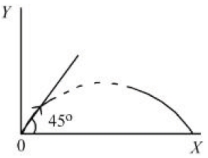
A particle of mass $100\,g$ is projected at time $t =0$ with a speed $20\,ms ^{-1}$ at an angle $45^{\circ}$ to the horizontal as given in the figure. The magnitude of the angular momentum of the particle about the starting point at time $t=2\,s$ is found to be $\sqrt{ K }\,kg\,m ^2 / s$. The value of $K$ is $............$ $\left(\right.$ Take $\left.g =10\,ms ^{-2}\right)$
The temperature of a gas is $-78^{\circ} \mathrm{C}$ and the average translational kinetic energy of its molecules is $\mathrm{K}$. The temperature at which the average translational kinetic energy of the molecules of the same gas becomes $2 \mathrm{~K}$ is :
In the figure one fourth part of $a$ uniform disc of radius $R$ is shown. The distance of the centre of mass of this object from centre $‘O’$ is:
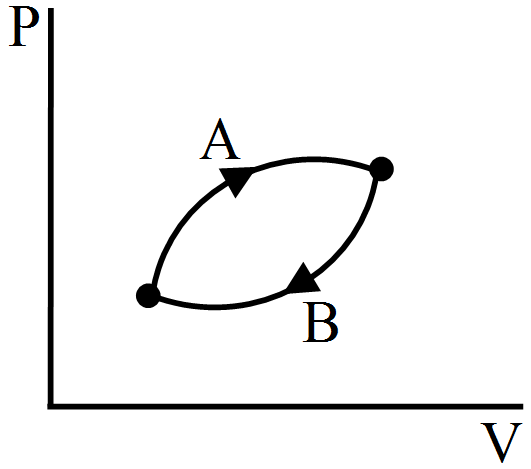
Refer to figure. Let $\Delta\text{U}_1$ and $\Delta\text{U}_2$ be the change in internal energy in processes A and B respectively, $\Delta\text{Q}$ be the net heat given to the system in process A + B and $\Delta \text{W}$ be the net work done by the system in the process A + B.

  1. $\Delta\text{U}_1+\Delta\text{U}_2=0$

  2. $\Delta\text{U}_1-\Delta\text{U}_2=0$

  3. $\Delta\text{Q}-\Delta\text{W}=0$

  4. $\Delta\text{Q}+\Delta\text{W}=0$

For a simple pendulum the graph between $L$ and $T$ will be.