Question
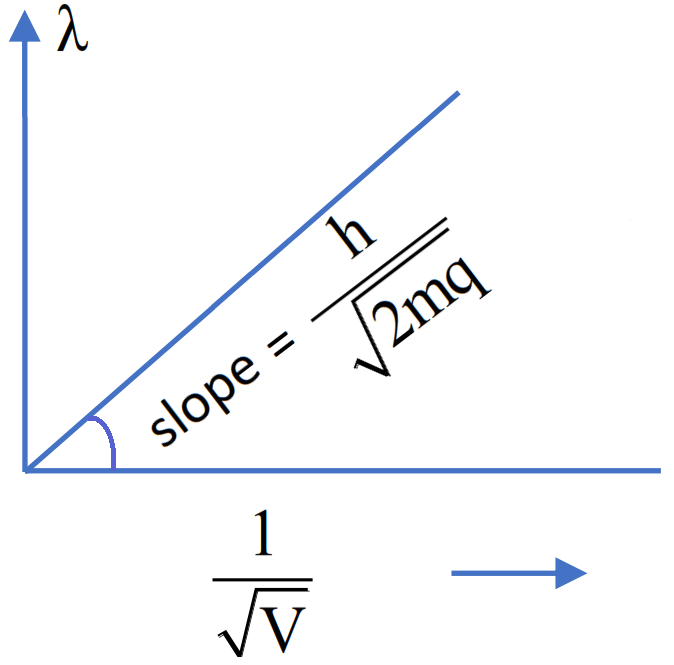
Plot a graph showing variation of de Broglie wavelength $(\lambda)$ associated with a charged particle of mass m, versus $\frac{1}{\sqrt{\text{V}}},$ where V is the potential difference through which the particle is accelerated. How does this graph give us the information regarding the magnitude of the charge of the particle?
Answer


The slope of the graph is $\frac{\text{h}}{\sqrt{2\text{mq}}}.$ Considering we know slope and mass of the charged particle, we can easily calculate the charge.
Need a full question paper?

Generate a complete, print-ready paper with questions like this in minutes — across 16+ boards, with answer keys.

Start Generating Free

Similar questions

$1 F\ ($farad$)$ is a very large unit for practical purposes. Explain with example.
The eyepiece of an astronomical telescope has a focal length of $10\ cm.$ The telescope is focused for normal vision of distant objects when the tube length is $1.0m.$ Find the focal length of the objective and the magnifying power of the telescope.
A beam of protons with a velocity $4 \times 10^5 m / s$ enters a uniform magnetic field of $0.3 T$ at an angle $60^{\circ}$ to the magnetic field. Find the radius of the helical path taken by the proton beam. Also find the pitch of the helix mp $=1.67 \times 10^{-27} k$
Explaination of experimental results of photoelectric effect with Einstein's equation.
What are the effects on the depletion layer when the diode is connected in forward bias and reverse bias condition?
Obtain the equation of electric potential energy of a system of two electric charges in external electric field.
Write and explain the law of conservation of electric charge.
The radii of curvature of the faces of a double convex lens are 10 cm and 15 cm. If focal length of the lens is 12 cm, find the refractive index of the material of the lens.
In the Rutherford's nuclear model of the atom, the nucleus (radius about $10^{-15} m$ ) is analogous to the sun about which the electron move in orbit (radius $\approx 10^{-10} m$ ) like the earth orbits around the sun. If the dimensions of the solar system had the same proportions as those of the atom, would the earth be closer to or farther away from the sun than actually it is? The radius of earth's orbit is about $1.5 \times 10^{11} m$. The radius of sun is taken as $7 \times 10^8 m$.
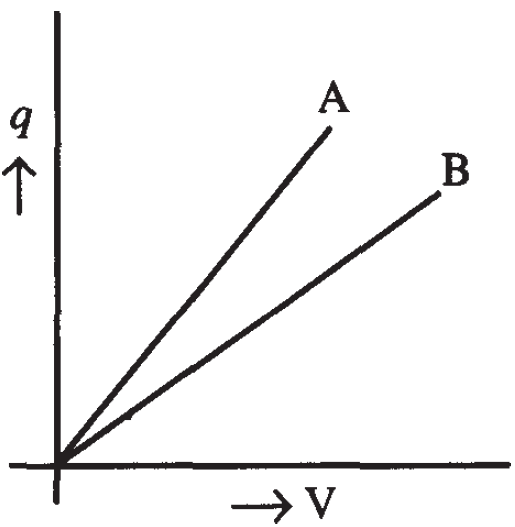
The given graph shows the variation of charge $q$ versus potential difference $V$ for two capacitors $C_1$ and $C_2.$ The two capacitors have same plate separation, but the plate area of $C_2$ is double than that of $C_1.$ Which of the lines in the graph correspond to $C_1$ and $C_2$ and why?