Question
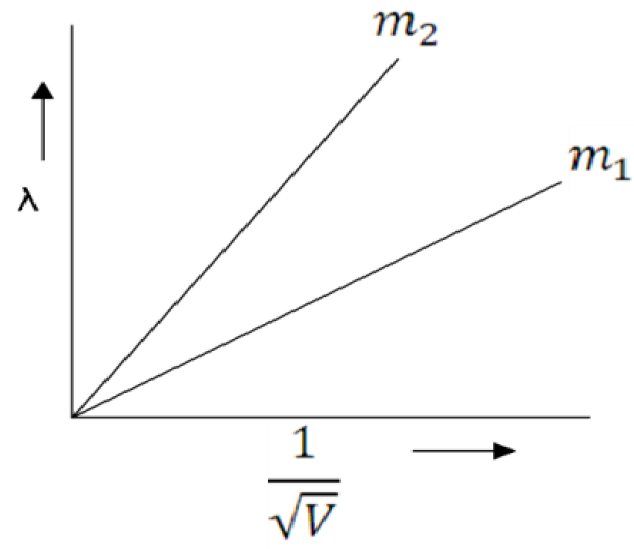
Plot a graph showing variation of de-Broglie wavelength $\lambda$ versus $\frac{1}{\sqrt{V}} ,$ where V is accelerating potential for two particles A and B carrying same charge but of masses $m_1, m_2\left(m_1>m_2\right)$. Which one of the two represents a particle of smaller mass and why?
Answer


As $\lambda = \frac{\hslash}{\sqrt{2\text{mqV}}}$
As the charge of two particles is same, therefore
$\frac{\lambda}{(\frac{1}{\sqrt{\text{V}}})} \alpha\frac{1}{\sqrt{\text{m}}}$ i.e.Slope $\alpha\frac{1}{\sqrt{\text{m}}}$
Hence, particle with lower mass ($\text{m}_{2}$) will have greater slope.

Need a full question paper?

Generate a complete, print-ready paper with questions like this in minutes — across 16+ boards, with answer keys.

Start Generating Free

Similar questions

Write briefly the underlying principle used in Davison-Germer experiment to verify wave nature of electrons experimentally. What is the de-Broglie wavelength of an electron with kinetic energy (of).120 ev? Write briefly the underlying principle used in Davison-Germer experiment to verify wave nature of electrons experimentally. What is the de-Broglie wavelength of an electron with kinetic energy (of).120 ev?
Define the ionisation energy. What is the value of it for hydrogen atom?
The changes in a function y and the independent dy variable x are related as $\frac{\text{dy}}{\text{dx}}=\text{x}^2.$ Find y as a function of x.
Explain emission lines and absorption lines.
A nearsighted person cannot clearly see beyond 200cm. Find the power of the lens needed to see objects at large distances.
Give examples where:
  1. The velocity of a particle is zero but its acceleration is not zero.
  2. The velocity is opposite in direction to the acceleration.
  3. The velocity is perpendicular to the acceleration.
Can a plane mirror ever form a real image?
The magnetic field in a plane electromagnetic wave is given by $B_y=\left(2 \times 10^{-7}\right) T \sin \left(0.5 \times 10^3 x+1.5 \times 10^{11} t\right)$.
(a) What is the wavelength and frequency of the wave?
(b) Write an expression for the electric field.
A convex lens of diameter 8.0cm is used to focus a parallel beam of light of wavelength 620nm. If the light be focused at a distance of 20cm from the lens, what would be the radius of the central bright spot formed?
In a Young's double slit experiment $\lambda=500\text{nm},$ d = 1.0mm and D = 1.0m. Find the minimum distance from the central maximum for which the intensity is half of the maximum intensity.