Question
  1. Plot a graph showing variation of voltage vs the current drawn from the cell. How can one get information from this plot about the emf of the cell and its internal resistance?
  2. Two cells of emf’s E1 and E2 and internal resistance r1 and r2 are connected in parallel. Obtain the expression for the emf and internal resistance of a single equivalent cell that can replace this combination?
Answer

Get the step-by-step solution for this question inside the Vidyadip app.

Get the answer in the app

Need a full question paper?

Generate a complete, print-ready paper with questions like this in minutes — across 16+ boards, with answer keys.

Start Generating Free

Similar questions

A steel frame $(\text{K}=45\text{Wm}^{-1}{^{\circ}}\text{C}^{-1})$of total length 60cm and cross sectional area 0.20cm2, forms three sides of a square. The free ends are maintained at 20°C and 40°C. Find the rate of heat flow through a cross section of the frame.


A long, straight wire carrying a current of 30A is placed in an external, uniform magnetic field of 4.0 × 10⁻⁴T parallel to the current. Find the magnitude of the resultant magnetic field at a point 2.0cm away from the wire.
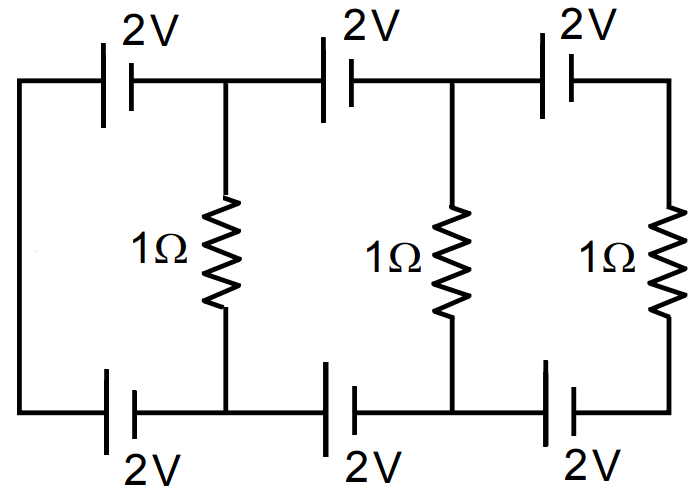
Find the circuit in the three resistors shown in the figure.

a. Derive an expression for the potential energy of an electric dipole in a uniform electric field. Explain conditions for stable and unstable equilibrium.
b. Is the electrostatic potential necessarily zero at a point where the electric field is zero? Give an example to support your answer.
Explain graphically the flow of current in semiconductors in the presence of an external electric field.
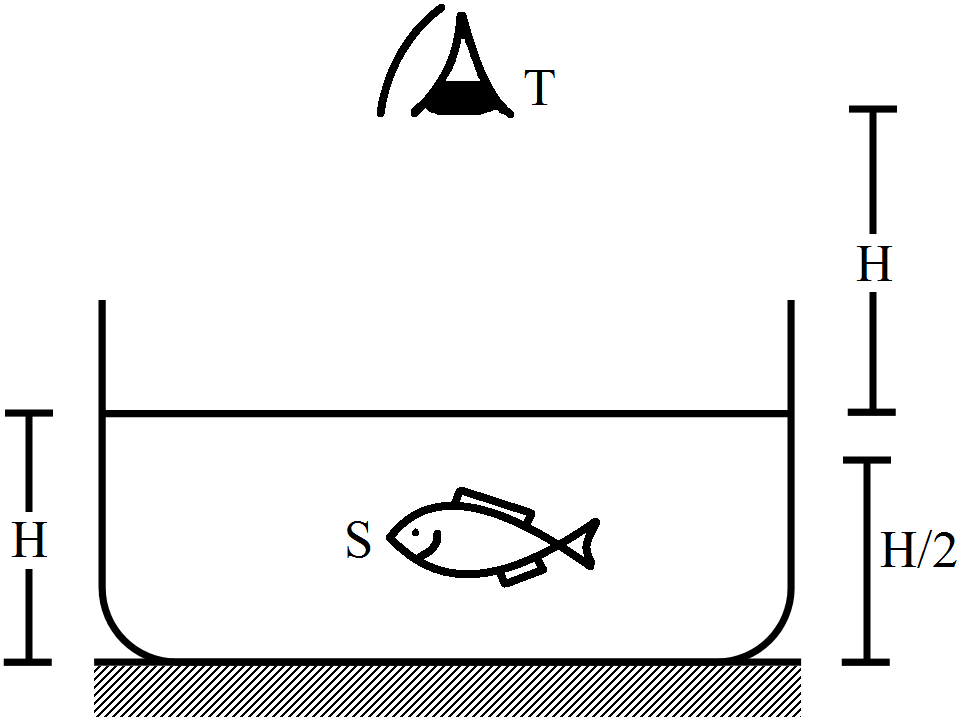
Consider the situation in figure. The bottom of the pot is a reflecting plane mirror, S is a small fish and T is a human eye. Refractive index of water is.
  1. At what distance(s) from itself will the fish see the image(s) of the eye?
  2. At what distance(s) from itself will the eye see the image(s) of the fish.

The resistance of an iron wire and a copper wire at 20°C are $3.9\Omega$ and $4.1\Omega,$ respectively. At what temperature will the resistance be equal? Temperature coefficient of resistivity for iron is $5.0\times10^{-3}\text{K}^{-1}$ and for copper, it is $4.0\times10^{-3}\text{K}^{-1}.$ Neglect any thermal expansion.
Two particles A and B of de Broglie wavelengths λ1 and λ2 combine to form a particle C. The process conserves momentum. Find the de Broglie wavelength of the particle C. (The motion is one dimensional).
An object 1.5 cm in size is placed on the side of the convex lens in the arrangement (a) above. The distance between the object and the convex lens is 40 cm. Determine the magnification produced by the two-lens system, and the size of the image.
(i) Obtain an expression for torque acting on a rectangular current carrying coil in a uniform magnetic field. (ii) Calculate magnetic dipole of a circular electric current loop.