Question
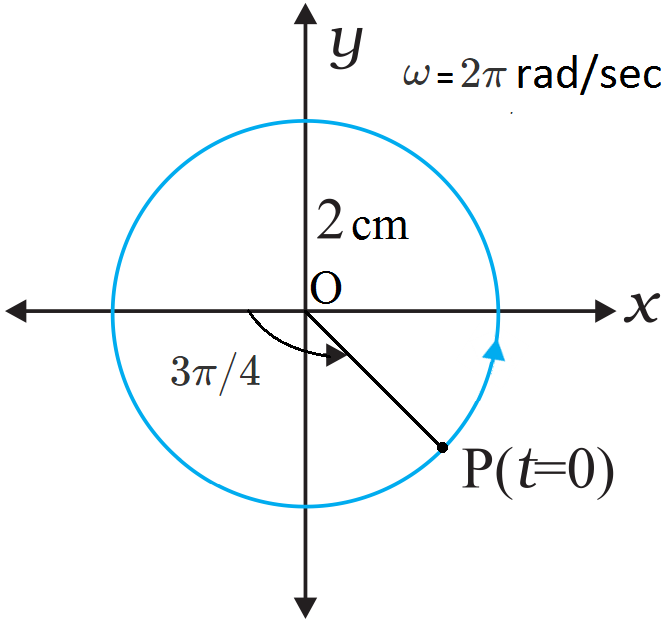
Plot the corresponding reference circle for each of the following simple harmonic motions. Indicate the initial (t = 0) position of the particle, the radius of the circle, and the angular speed of the rotating particle. For simplicity, the sense of rotation may be fixed to be anticlockwise in every case: (x is in cm and t is in s).$\text{x}=3\sin\Big(2\pi\text{t}+\frac{\pi}{4}\Big)$
Answer

$\text{x}=3\sin\Big(2\pi\text{t}+\frac{\pi}{4}\Big)$$=-3\cos\bigg[\Big(2\pi\text{t}+\frac{\pi}{4}\Big)+\frac{\pi}{2}\bigg]=-3\cos\Big(2\pi\text{t}+\frac{3\pi}{4}\Big)$
If this equation is compared with the standard SHM equation $\text{x}=\text{A}\cos\bigg(\Big(\frac{2\pi}{\text{T}}\Big)\text{t}+\phi\bigg),$ then we get:
Amplitude, A = 3cm
Phase angle, $\phi=\frac{3\pi}{4}=135^\circ$
Angular velocity, $\omega=\frac{2\pi}{\text{T}}=2\pi\text{ rad/s}$
The motion of the particle can be plotted as shown in the following figure.

Need a full question paper?

Generate a complete, print-ready paper with questions like this in minutes — across 16+ boards, with answer keys.

Start Generating Free

Similar questions

Write the dimensional formula for the following:
  1. Wein’s constant.
  2. Planck's constant.
  3. Specific heat.
  4. Latent heat.
  5. Rydberg's constant.
The resultant of two vector $\vec{P}$ and $\vec{Q}$ is $\vec{R}$. If the direction of $\vec{Q}$ is reversed, then the resulting vector becomes $\vec{S}$. Then prove that,
$
R ^2+ S ^2=2\left( P ^2+ Q ^2\right)
$
A beam of light having wavelengths distributed uniformly between 450nm to 550nm passes through a sample of hydrogen gas. Which wavelength will have the least intensity in the transmitted beam?
Is it easier to take out a nucleon from carbon or from iron? Fi$-$om iron or from lead?
The principle of ‘parallax’ in section $2.3.1$ is used in the determination of distances of very distant stars. The baseline AB is the line joining the Earth’s two locations six months apart in its orbit around the Sun. That is, the baseline is about the diameter of the Earth’s orbit $\approx 3 \times 10^{11}m$. However, even the nearest stars are so distant that with such a long baseline, they show parallax only of the order of $1”$ (second) of arc or so. A parsec is a convenient unit of length on the astronomical scale. It is the distance of an object that will show a parallax of $1”$ (second of arc) from opposite ends of a baseline equal to the distance from the Earth to the Sun. How much is a parsec in terms of metres?
A particle of mass $10g$ is placed in a potential field given by $U = 50x^2 + 100 erg/gm$. Calculate the frequency of oscillation.
A particle has a displacement of $12m$ towards east and $5m$ towards north and 6m vertically upwards. Find the magnitude of the sum of these displacements.
A man of mass 70kg stands on a weighing scale in a lift which is moving. What would be the reading if the lift mechanism failed and it hurtled down freely under gravity?
From the top of a tower $100m$ in height, a ball is dropped and at the same time another ball is projected vertically upwards from the ground with a velocity of $25ms^{-1}$. Find when and where the two balls will meet? $g = 9.8ms^{-2}​​​​​​​$?
The current generator $I_g$ shown in figure, sends a constant current i through the circuit. The wire cd is fixed and ab is made to slide on the smooth, thick rails with a constant velocity v towards right. Each of these wires has resistance r. Find the current through the wire cd.