Question
Plot the corresponding reference circle for each of the following simple harmonic motions. Indicate the initial (t = 0) position of the particle, the radius of the circle, and the angular speed of the rotating particle. For simplicity, the sense of rotation may be fixed to be anticlockwise in every case: (x is in cm and t is in s).$\text{x}=3\sin\Big(2\pi\text{t}+\frac{\pi}{4}\Big)$
Answer

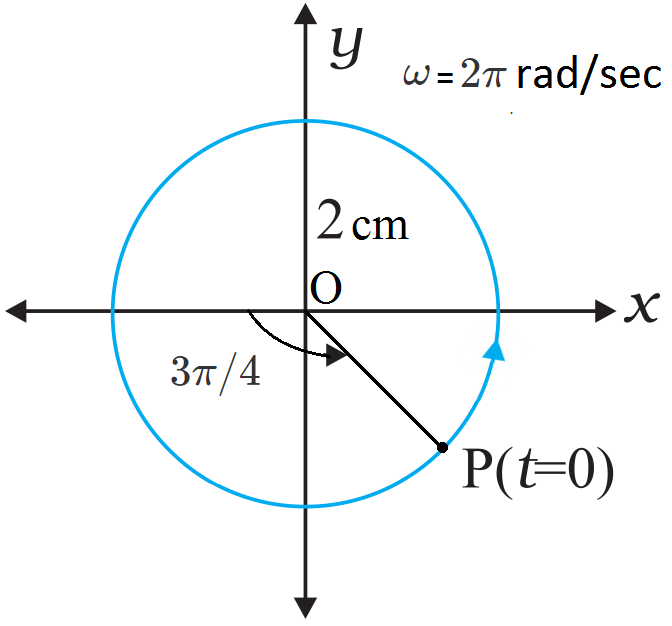
$\text{x}=3\sin\Big(2\pi\text{t}+\frac{\pi}{4}\Big)$$=-3\cos\bigg[\Big(2\pi\text{t}+\frac{\pi}{4}\Big)+\frac{\pi}{2}\bigg]=-3\cos\Big(2\pi\text{t}+\frac{3\pi}{4}\Big)$
If this equation is compared with the standard SHM equation $\text{x}=\text{A}\cos\bigg(\Big(\frac{2\pi}{\text{T}}\Big)\text{t}+\phi\bigg),$ then we get:
Amplitude, A = 3cm
Phase angle, $\phi=\frac{3\pi}{4}=135^\circ$
Angular velocity, $\omega=\frac{2\pi}{\text{T}}=2\pi\text{ rad/s}$
The motion of the particle can be plotted as shown in the following figure.

Need a full question paper?

Generate a complete, print-ready paper with questions like this in minutes — across 16+ boards, with answer keys.

Start Generating Free

Similar questions

A steel wire of mass 4.0g and length 80cm is fixed at the two ends. The tension in the wire is 50N. Find the frequency and wavelength of the fourth harmonic of the fundamental.
Consider the decay of a free neutron at rest: $n → p + e^-$ Show that the two-body decay of this type must necessarily give an electron of fixed energy and, therefore, cannot account for the observed continuous energy distribution in the β-decay of a neutron or a nucleus.

 [Note: The simple result of this exercise was one among the several arguments advanced by W. Pauli to predict the existence of a third particle in the decay products of β-decay. This particle is known as neutrino. We now know that it is a particle of intrinsic spin ½ (like $e^-$, p or n), but is neutral, and either massless or having an extremely small mass (compared to the mass of electron) and which interacts very weakly with matter. The correct decay process of neutron is: $n → p + e^- + v]$
A policeman on duty detects a drop of 15% in the pitch of the horn of a motor car as it crosses him. If the velocity of sound is 330m/sec, calculate the speed of the car.
Considering the pressure p to be proportional to the density, find the pressure p at a height h if the pressure on the surface of the earth is $p_0$.
Can we perform Young's double slit experiment with sound waves? To get a reasonable "fringe pattern", what should be the order of separation between the slits? How can the bright fringes and the dark fringes be detected in this case?
The length of a rod is exactly $1m$ when measured at rest. What will be its length when it moves at a speed of:
a. $3 \times 10^5 \mathrm{~m} / \mathrm{s}$.
b. $3 \times 10^6 \mathrm{~m} / \mathrm{s}$.
c. $3 \times 10^7 \mathrm{~m} / \mathrm{s}$.
The radius of a sphere is measured as $(2.1 \pm 0.5) \text{cm}$ calculate its surface area with error limits.
Suppose the platform with the kid in the previous problem is rotating in anticlockwise direction at an angular speed $\omega.$ The kid starts walking along the rim with a speed v relative to the platform also in the anticlockwise direction. Find the new angular speed of the platform.
A vessel contains two non$-$reactive gases: neon $($monoatomic$)$ and oxygen $($diatomic$)$. The ratio of their partial pressures is $3: 2$. Estimate the ratio of $(i)$ number of molecules, $(ii)$ mass density of neon and oxygen in the vessel. Atomic mass of $\mathrm{Ne}=20.2 \mathrm{u}$, molecular mass of $\mathrm{O}_2=32.0 \mathrm{u}$.
An artificial satellite is moving in a circular orbit around the earth with a speed equal to half the magnitude of escape velocity from earth. Determine
  1. The height of satellite above earth's surface.
  2. If the satellite is suddenly stopped, find the speed with which the satellite will hit the earth's surface after falling down.