Question
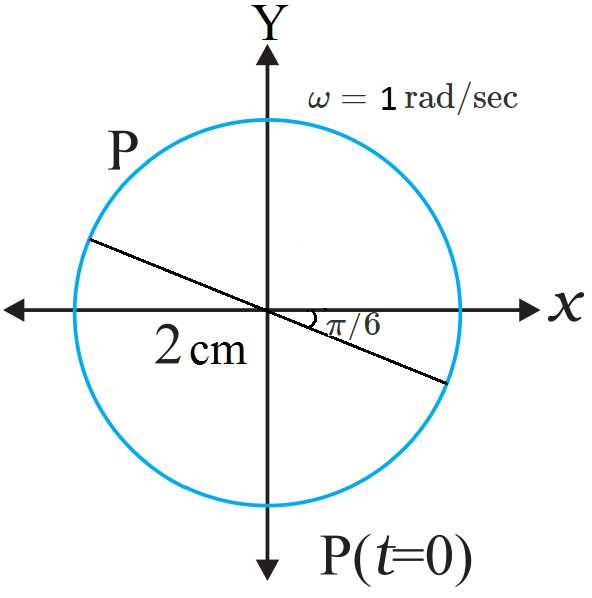
Plot the corresponding reference circle for each of the following simple harmonic motions. Indicate the initial (t = 0) position of the particle, the radius of the circle, and the angular speed of the rotating particle. For simplicity, the sense of rotation may be fixed to be anticlockwise in every case: (x is in cm and t is in s).$\text{x}=\cos\Big(\frac{\pi}{6}-\text{t}\Big)$
Answer

$\text{x}=\cos\Big(\frac{\pi}{6}-\text{t}\Big)=\cos\Big(\text{t}-\frac{\pi}{6}\Big)$If this equation is compared with the standard SHM equation $\text{x}=\text{A}\cos\bigg(\Big(\frac{2\pi}{\text{T}}\Big)\text{t}+\phi\bigg),$ then we get:
Amplitude, A = 1
Phase angle, $\phi=-\frac{\pi}{6}=-30^\circ$
Angular velocity, $\omega=\frac{2\pi}{\text{T}}=1\text{rad/s}$
The motion of the particle can be plotted as shown in the following figure.

Need a full question paper?

Generate a complete, print-ready paper with questions like this in minutes — across 16+ boards, with answer keys.

Start Generating Free

Similar questions

At what distance should two charges, each equal to $1C$, be placed so that the force between them equals your weight?
If the acceleration due to gravity on moon is one sixth that on the earth what will be the length and time period of a second's pendulum there? (g = 9.8 ms?)
How many time constants will elapse before the current in a charging RC circuit drops to half of its initial value? Answer the same question for a discharging RC circuit.
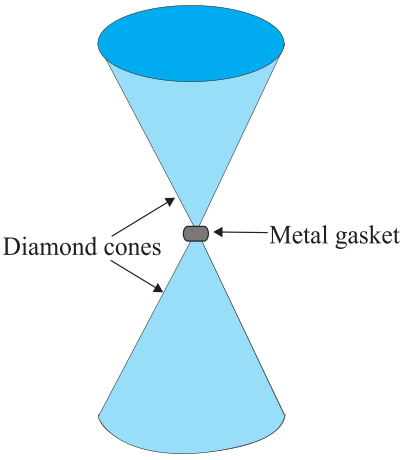
Anvils made of single crystals of diamond, with the shape as shown in Fig., are used to investigate behaviour of materials under very high pressures. Flat faces at the narrow end of the anvil have a diameter of $0.50mm$, and the wide ends are subjected to a compressional force of $50,000N$. What is the pressure at the tip of the anvil?
Given a + b + c + d = 0, which of the following statements are correct: a, b, c, and d must each be a null vector.
The displacement of a progressive wave is represented by $\text{y} = \text{A} \sin(\omega \text{t} – \text{k x} ),$ where $x$ is distance and $t$ is time. Write the dimensional formula of $(i) \omega$ and $(ii) k.$
The product of the hole concentration and the conduction electron concentration turns out to be independent of the amount of any impurity doped. The concentration of conduction electrons in germanium is $6 \times 10^{19}$ per cubic metre. When some phosphorus impurity is doped into a germanium sample, the concentration of conduction electrons increases to $2 \times 10^{23}$ per cubic metre. Find the concentration of the holes in the doped germanium.
A light ray is incident at an angle of 45° with the normal to a $\sqrt{2}\text{cm}$ thick plate $(\mu = 2.0)$. Find the shift in the path of the light as it emerges out from the plate.
A ball falls on the ground from a height of 2.0m and rebounds up to a height of 1.5m. Find the coefficient of restitution.
Calculate the magnetic dipole moment corresponding to the motion of the electron in the ground state of a hydrogen atom.