Question
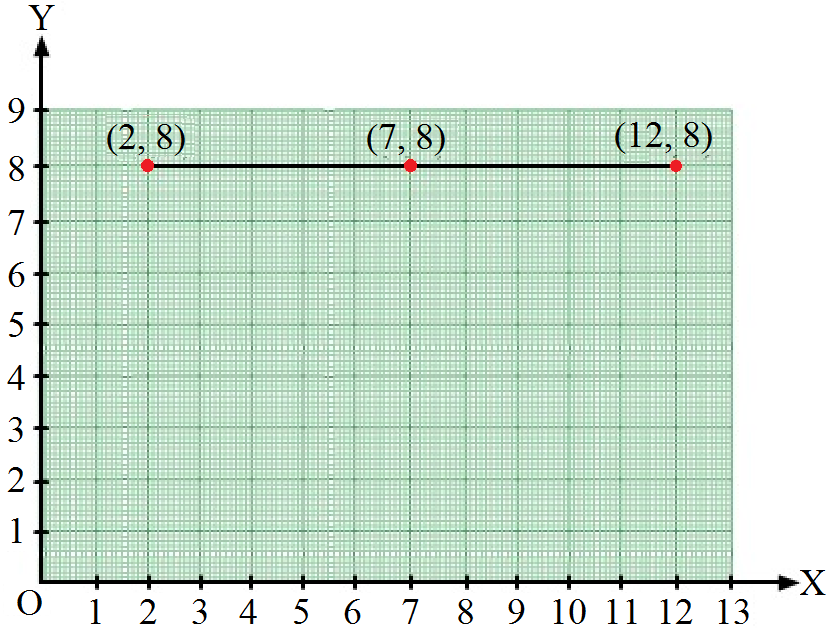
Plot the points (2, 8), (7, 8) and (12, 8). Join these points in pairs. Do they lie on a line? What do you observe?
Answer


  • Take a point O on the graph paper and draw the horizontal and vertical lines OX and OY respectively.
  • Then, let on the x-axis and y axis 1cm represents 1 unit.
  • In order to plot point (2, 8), we start from the origin O and move 8cm along OX. The point we arrive at is (2, 8).
  • To plot point (7, 8), we move 7cm along OX and 8cm along OY. The point we arrive at is (7, 8).
  • To plot point (12, 8), we move 12cm along OX and 8cm along OY. The point we arrive at is (12, 8).
  • From the graph below, it can be seen that the points lie on a line parallel to x-axis because they have the same y-coordinate.

Need a full question paper?

Generate a complete, print-ready paper with questions like this in minutes — across 16+ boards, with answer keys.

Start Generating Free

Similar questions

Plot the points A(2, 4) and B(4, 2) on a graph sheet and draw a line passing through these two points. Extend the line on both sides to meet the coordinate axes. What are the coordinates of the points where this line meets the x-axis and the y-axis?
The volume of a cylinder of height 8 cm is $1232 cm^3$. Find its curved surface area and the total surface area.
Construct a rhombus ABCD in which AB = 4cm and diagonal AC is 6.5cm.
The total surface area of a hollow cylinder which is open from both sides is 4620 sq.cm, area of base ring is 115.5 sq.cm and height 7cm. Find the thickness of the cylinder.
A shopkeeper marks his goods at 40% above the cost price but allow a discount of 5% for cash payment to his custmers. What actual profit does he make, if he recevies Rs. 1064 after paying the discount?
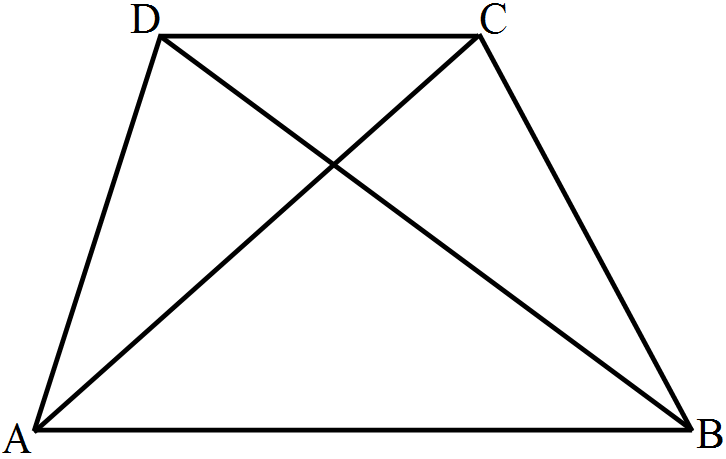
In the adjoining figure, ABCD is a quadrilateral.
  1. How many pairs of adjacent sides are there? Name them.
  2. How many pairs of opposite sides are there? Name them.
  3. How many pairs of adjacent angles are there? Name them.
  4. How many pairs of opposite angles are there? Name them.
  5. How many diagonals are there? Name them.
Prove that the sum of the angles of a quadrilateral is 360°.
Construct a quadrilateral PQRS in which PQ = 4.2cm, $\angle\text{PQR}=60^\circ,\angle\text{QPS}=120^\circ,$ QR = 5cm and PS = 6cm.
The curved surface area of a cylinder is $4400 cm^2$ and the circumference of its base is 110 cm . Find the volume of the cylinder.
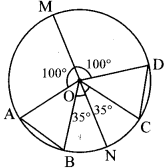
In the given figure, O is the centre of the circle whose diameter is MN. Measures of some central angles are given in the figure.
i. m∠AOB and m∠COD
ii. Show that arc AB ≅ arc CD
iii. Show that chord AB ≅ chord CD
Image