MCQ
Pneumatic bones of birds
- AIncrease the respiratory rate
- BIncrease the heart beat rate
- CIncrease the $CO_2$ output
- ✓Increase the buoyancy
Generate a complete, print-ready paper with questions like this in minutes — across 16+ boards, with answer keys.
$\begin{array}{|p{0.3\linewidth}|l|} \hline Column-I & Column-II \\ \hline 1.\,\,Exoskeleton & p.\;Thorax \\ \hline 2.\,\,Three\,\,ganglion & q.\;Chitin \\ \hline 3.\,\,One\,\,pair\,\,of\,\,seminal\,\,vesicle & r.\;6^{th}-7^{th}\,\,segments\;\;of\;\;abdomen \\ \hline 4.\,\,Mushroom\,\,shaped & s.\;6^{th}\,\,segments \\ \hline \end{array}$
(i) First rise of saline = $10 \,ml$
(ii) Second rise of saline after adding $KOH = 30 \,ml$
$I$. $ECG$ is of a great clinical significance
$II$. Electrocardiograph is the recording of electrical changes in cardiac muscles during the cardiac cycle
$III$. To obtain a standard $ECG$, a patient is connected to the machine with $3$ electrical electrodes (one to each wrist and to the left ankle)
$IV$. Normal activities of the heart are regulated intrinsically
$V$. Electrocardiogram is the electrical activity of heart
The option with correct statements is
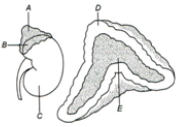
|
Column $-I$ |
Column $-II$ |
|
$A.$ Zona reticularis |
$1.$ Outer layer (adrenal cortex) |
|
$B.$ Zona fascicular |
$2.$ Inner layer (adrenal cortex) |
|
$C.$ Zona glomerulosa |
$3.$ Middle layer (adrenal cortex) |