MCQ
Point $A$ is at a lower electrical potential than point $B$. An electron between them on the line joining them will:
  • A
    Move towards $A$
  • Move towards $B$
  • C
    Move at right angles to the line joining $A$ and $B$
  • D
    Remain at rest

Answer

Correct option: B.
Move towards $B$

Given that point $A$ is at lower electric potential than point $B$. The electron between them on line joining will move.
We have to find where this electron moves.
Since we know that electric currents move from a higher potential or a lower potential. Also, electrons move in the direction opposite to electric current. So the electron on the line joining two points $A$ and $B$ will move from lower to higher potential i.e, it will move towards $B.$

Need a full question paper?

Generate a complete, print-ready paper with questions like this in minutes — across 16+ boards, with answer keys.
Start Generating Free

Similar questions

A donor atom in a semiconductor has a loosely bound electron. The orbit of this electron is considerly affected by the semiconductor material but behaves in many ways like an electron orbiting a hydrogen nucleus. Given that the electron has an effective mass of $0.07 \,m_e$, where $m_e$ is mass of the free electron and the space in which it moves has a permittivity $13 \,\varepsilon_0$, then the radius of the electron's lowermost energy orbit will be close to ................. $\mathring A$ (take, the Bohr radius of the hydrogen atom is $0.53 \mathring A$ )
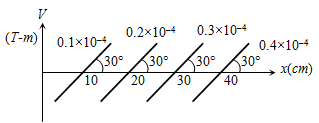
Some equipotential surfaces of the magnetic scalar potential are shown in the figure. Magnetic field at a point in the region is
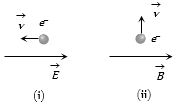
An electron is moving through a field. It is moving $(i)$ opposite an electric field $(ii)$ perpendicular to a magnetic field as shown. For each situation the de-Broglie wave length of electron
Plane polarised light is passed through a polaroid. On viewing through the polaroid we find that when the polariod is given one complete rotation about the direction of the light, one of the following is observed
If a conductor has a potential $V \neq 0$ and there are no charges anywhere else outside, then:
The activity of a freshly prepared radioactive sample is $10^{10}$ disintegrations per second, whose mean life is $10^9 s$. The mass of an atom of this radioisotope is $10^{-25} kg$. The mass (in $mg$ ) of the radioactive sample is
The magnetic moment of a current (l) carrying circular coil of radius (r) and number of turns (n) varies as
Electric flux per unit solid angle is defined as:
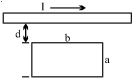
A long straight wire is parallel to one edge as in fig. If the current in the long wire is varies in time as $I = I_0e^{-t/\tau}$, what will be the induced $emf $ in the loop?
A dense collection of equal number of electrons and positive ions is called neutral plasma. Certain solids containing fixed positive ions surrounded by free electrons can be treated as neutral plasma. Let ' $N$ ' be the number density of free electrons, each of mass ' $m$ '. When the electrons are subjected to an electric field, they are displaced relatively away from the heavy positive ions. If the electric field becomes zero, the electrons begin to oscillate about the positive ions with a natural angular frequency ' $\omega_p$ ', which is called the plasma frequency. To sustain the oscillations, a time varying electric field needs to be applied that has an angular frequency $\omega$, where a part of the energy is absorbed and a part of it is reflected. As $\omega$ approaches $\omega_{ p }$, all the free electrons are set to resonance together and all the energy is reflected. This is the explanation of high reflectivity of metals.

$1.$ Taking the electronic charge as ' $e$ ' and the permittivity as ' $\varepsilon_0$ ', use dimensional analysis to determine the correct expression for $\omega_p$.

$(A)$ $\sqrt{\frac{N e}{m \varepsilon_0}}$ $(B)$ $\sqrt{\frac{m \varepsilon_0}{N e}}$ $(C)$ $\sqrt{\frac{N e^2}{m \varepsilon_0}}$ $(D)$ $\sqrt{\frac{m \varepsilon_0}{N e^2}}$

$2.$ Estimate the wavelength at which plasma reflection will occur for a metal having the density of electrons $N \approx 4 \times 10^{27} m ^{-3}$. Take $\varepsilon_0 \approx 10^{-11}$ and $m \approx 10^{-30}$, where these quantities are in proper $SI$ units.

$(A)$ $800 \ nm$ $(B)$ $600 \ nm$ $(C)$ $300 \ nm$ $(D)$ $200 \ nm$

Give the answer question $1$ and $2.$