MCQ
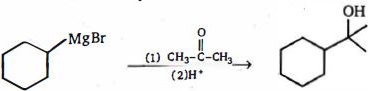
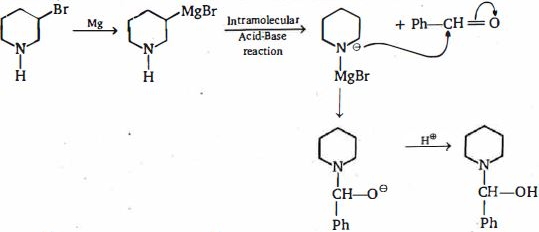
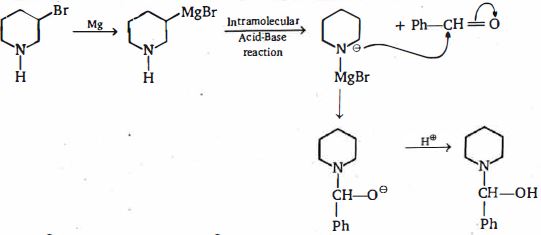
Point out the incorrect synthesis
  • A


  • C

  • D
    $PhMgBr\xrightarrow[{(2)\,{H^ + }}]{{(1)\,HCHO}}Ph - C{H_2} - OH$
Answer

Correct option: B.

b

Need a full question paper?

Generate a complete, print-ready paper with questions like this in minutes — across 16+ boards, with answer keys.

Start Generating Free

Similar questions

Sodium sulphate dissolves in water with evolution of heat. Consider a saturated solution of sodium sulphate. If the temperature is raised, then according to Le-Chatelier principle
Solubility of calcium phosphate $($molecular mass, $M)$ in water is $W _{ g }$ per $100 \ mL$ at $25^{\circ} C$. Its solubility product at $25^{\circ} C$ will be approximately.
The bond angles in methane $(I),$ ammonia $(II)$ and trimethyl amine $(III)$ increase in the order :
When iodine is dissolved in aqueous potassium iodide, the shape of the species formed is
An organic compound $'A'$ $(C_{9} H _{10} O$ ) when treated with conc. $HI$ undergoes cleavage to yield compounds $'B'$ and $'C'.$ $'B'$ gives yellow precipitate with $AgNO _{3}$ where as $'C'$ tautomerizes to $D ^{\prime} .$ $'D'$ gives positive idoform test. $'A'$ could be :
What is the potential of the cell containing two hydrogen electrodes as represented below ........... $\mathrm{V}$

$Pt:\frac{1}{2}\,{H_2}\left( g \right)\,|{H^ + }\left( {{{10}^{ - 8}}\,M} \right)||{H^ + }\,\left( {{{10}^{ - 3}}\,M} \right)|\frac{1}{2}\,{H_2}\left( g \right)\,;Pt$

A $1.84\,mg$ sample of polyhydric alcoholic compound ' $X$ ' of molar mass $92.0\,g / mol$ gave $1.344\,mL$ of $H _{2}$ gas at $STP$. The number of alcoholic hydrogens present in compound ' $X$ ' is $.....$
The largest bond angle is in
Match List-I with List-II.
List-I
(Complex)}
List-II
(Hybridisation of central metal ion)
(A) $\left[\mathrm{CoF}_{6}\right]^{3-}$(I) $ d^2 sp ^3$
(B) $\left[\mathrm{NiCl}_{4}\right]^{2}$(II) $sp ^3$
(C) $\left[\mathrm{Co}\left(\mathrm{NH}_{3}\right)_{6}\right]^{3+}$(III) $ sp ^3 d^2$
(D) $\left[\mathrm{Ni}(\mathrm{CN})_{4}\right]^{2-}$(IV) $dsp ^2$

Choose the correct answer from the options given
Rate constant for a chemical reaction taking place at $500\, K$, is expressed as $K = A\, e^{-1000}$. The activation energy of the reaction is