MCQ
Point out the wrong statement in relation to enthalpy
- AIt is a state function
- ✓It is an intensive property
- CIt is independent of the path followed for the change
- DIts value depends upon the amount of substance in the system
Generate a complete, print-ready paper with questions like this in minutes — across 16+ boards, with answer keys.
$\begin{array}{*{20}{c}}
{OH\,\,\,\,\,\,\,\,\,\,\,\,\,\,\,\,\,\,\,\,\,\,\,\,\,\,\,\,\,\,\,\,\,\,\,\,\,} \\
{|\,\,\,\,\,\,\,\,\,\,\,\,\,\,\,\,\,\,\,\,\,\,\,\,\,\,\,\,\,\,\,\,\,\,\,\,\,\,\,\,\,\,} \\
{C{H_3} - CH - C{H_2} - C{H_2} - OH}
\end{array}\,$ ${\xrightarrow[{Pyridine{\kern 1pt} cold}]{{Cr{O_3}}}}$ Product
$C{u_{\left( s \right)}} + 2Ag_{\left( {aq} \right)}^ + \to Cu_{\left( {aq} \right)}^{2 + } + 2A{g_{\left( s \right)}}$
$A$. A liquid evaporates to vapour.
$B$. Temperature of a crystalline solid lowered from $130 \mathrm{~K}$ to $0 \mathrm{~K}$.
$C$. $2 \mathrm{NaHCO}_{3(\mathrm{~s})} \rightarrow \mathrm{Na}_2 \mathrm{CO}_{3(\mathrm{~s})}+\mathrm{CO}_{2(\mathrm{~g})}+\mathrm{H}_2 \mathrm{O}_{(\mathrm{g})}$
$D$. $\mathrm{Cl}_{2(g)} \rightarrow 2 \mathrm{Cl}_{(g)}$
Choose the correct answer from the options given below:

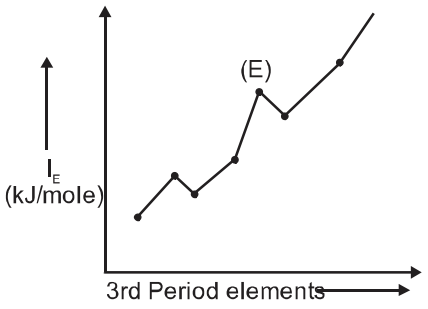
${Image}$ Choose the correct answer from the following options