MCQ
Point out the wrong statement in relation to the structure of benzene
  • It forms only one monosubstitution product
  • B
    The $C - C$ bond distance in benzene is uniformly $1.397 \,\mathop A\limits^o $
  • C
    It is a resonance hybrid of a number of canonical forms
  • D
    It has three delocalised $\pi $- molecular orbitals
Answer

Correct option: A.
It forms only one monosubstitution product
a
It’s obvious.

Need a full question paper?

Generate a complete, print-ready paper with questions like this in minutes — across 16+ boards, with answer keys.

Start Generating Free

Similar questions

For a chemical reaction....can never be a fraction
Inorganic graphite is:
$L$-isomer of tetrose $X \left( C _4 H _8 O _4\right)$ gives positive Schiff's test and has two chiral carbons. On acetylation. ' $X$ ' yields triacetate. ' $X$ ' also undergoes following reactions

$' A ^{\prime} \stackrel{ HNO _3}{\longrightarrow} X ^{\prime} \stackrel{ NaBH _4}{\longrightarrow} \underset{\text { Chiral compound }}{\text { } B ^{}}$ $X$ is $.......$.

$\begin{matrix}
   C{{H}_{2}}-O-COR\,  \\
   |\,\,\,\,\,\,\,\,\,\,\,\,\,\,\,\,\,\,\,\,\,\,\,\,\,\,\,\,\,\,\,\,\,\,\,\,\,\,\,\,\,  \\
   CH-O-CO{{R}_{2}}\,  \\
   |\,\,\,\,\,\,\,\,\,\,\,\,\,\,\,\,\,\,\,\,\,\,\,\,\,\,\,\,\,\,\,\,\,\,\,\,\,\,\,\,\,\,  \\
   C{{H}_{2}}-O-CO{{R}_{3}}  \\
\end{matrix}+3NaOH\to (A)+ $ Salt of fatty acid (soap)

Product $(A)$ of the reaction is

The outer most shell electronic configuration of transition element is
The end product $(C)$ in the following sequence of reactions is
 
$HC\, \equiv \,CH\,\xrightarrow[{20\% \,{H_2}S{O_4}}]{{1\% \,HgS{O_4}}}A$ $\xrightarrow[{{H_2}O}]{{C{H_3}MgX}}B\xrightarrow{{[O]}}(C)$
 
Assign $A, B, C, D$ from given type of reaction.

${N_2} + 3{H_2} \longrightarrow NH_3$

Which of the following statements is incorrect ?
An organic compound $\mathrm{A}\left(\mathrm{C}_{6} \mathrm{H}_{6} \mathrm{O}\right)$ gives dark green colouration with ferric chloride. On treatment with $\mathrm{CHCl}_{3}$ and $\mathrm{KOH}$, followed by acidification gives compound $\mathrm{B}$. Compound $B$ can also be obtained from compound $\mathrm{C}$ on reaction with pyridinium chlorochromate $(PCC).$ Identify $A, B$ and $C.$
In the following compounds

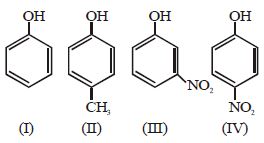
The order of acidity is