MCQ
Points $(1, -1), (2, -2), (-3, -4), (4, -5)$
  • All lie in the $II$ quadrant.
  • B
    All in the $III$ quadrant.
  • C
    All lie in the $IV$ quadrant.
  • D
    Do not lie in the same quadrant.

Answer

Correct option: A.
All lie in the $II$ quadrant.
Points $(1,-1),(2,-2)$ and $(4,-5)$ lie in Quadrant $IV,$ but point $(-3,-4)$ lies in Quadrant $III$. Hence, all the given points do not lie in the same quadrant.

Need a full question paper?

Generate a complete, print-ready paper with questions like this in minutes — across 16+ boards, with answer keys.

Start Generating Free

Similar questions

In $\angle\text{ABC}$ and $\angle\text{DEF}, AB = DE$ and $\angle\text{A} = \angle\text{D}.$ Then, the two triangles will be congruent by $SAS$ axiom if:
In the following, write the correct answer.
In $\triangle\text{ABC}$ if $BC = AB$ and $\angle\text{B}=80^{\circ}$ then is equal to:
The value of $\frac{(a+b)^2}{(b-c)(c-a)}+\frac{(b+c)^2}{(a-b)(c-a)}+\frac{(c+a)^2}{(a-b)(b-c)}$ is
The class marks of a frequency distribution are $15, 20, 25, 30 ...., .$ The class corresponding to the class mark $20$ is:
$ABCD$ is a trapezium in which $\text{AB || DC}.$ $M$ and $N$ are the mid-points of $AD$ and $BC$ respectively. If $AB = 12\ cm, MN = 14\ cm$, then $CD = ?$
The table given below shows the month of birth of $36$ students of a class.
Month of birth
Jan.
Feb.
March
April
May
June
July
Aug.
Sept.
Oct.
Nov.
Dec.
No. of students
$4$
$3$
$5$
$0$
$1$
$6$
$1$
$3$
$4$
$3$
$4$
$3$
A student is chosen at random from the class. What is the probability that the chosen student was born in October$?$
How many planks of dimensions $(5m × 25m × 10\ cm)$ can be stored in a pit which is $20m$ long, $6m$ wide and $50\ cm$ deep$?$
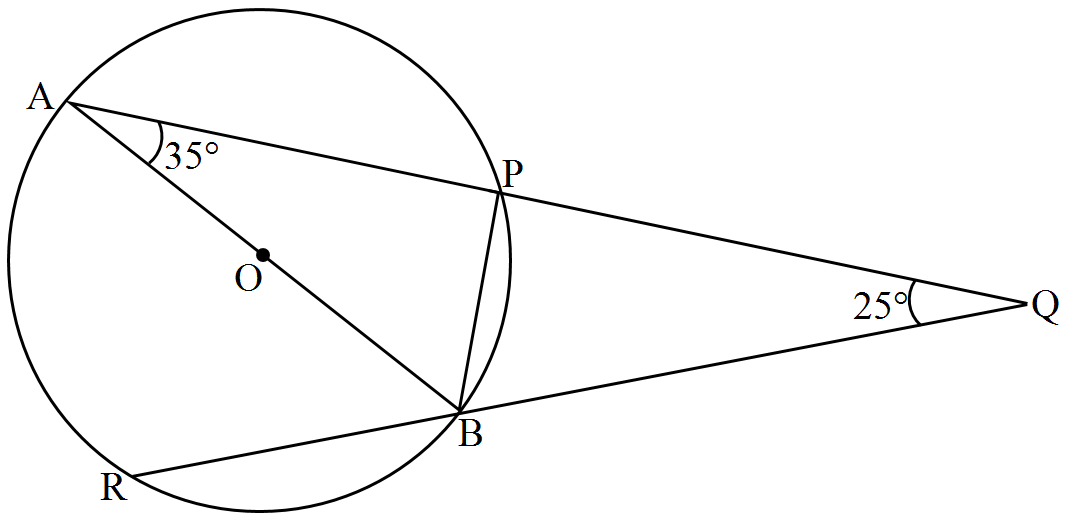
In the given figure, $AB$ is a diameter of the circle $APBR.\ APQ$ and $RBQ$ are straight lines. If $\angle\text{A}=35^\circ$ and then the measure of $\angle\text{PBR}$ is:
We get a rhombus by joining the mid-points of the sides of a
$ABCD$ is a trapezium with parallel sides $AB = a$ and $DC = b$. If $E$ and $F$ are mid-points of non-parallel sides $AD$ and $BC$ respectively, then the ratio of areas of quadrilaterals $ABFE$ and $EFCD$ is: