MCQ
Positive rays was discovered by
  • Thomson
  • B
    Goldstein
  • C
    W. Crookes
  • D
    Rutherford

Answer

Correct option: A.
Thomson
a
(a)Positive rays was discovered by J.J. Thomson.

Need a full question paper?

Generate a complete, print-ready paper with questions like this in minutes — across 16+ boards, with answer keys.
Start Generating Free

Similar questions

The intensity of direct sunlight on a surface normal to the rays is ${I_0}$. What is the intensity of direct sunlight on a surface, whose normal makes an angle of $60^{o}$ with the rays of the sun
Two identical circular loops are moving with same kinetic energy one rolls $\&$ other slides. The ratio of their speed is 
An electron, a proton and an alpha particle having the same kinetic energy are moving in circular orbits of radii $r_e,r_p$ and ${r_\alpha }$ respectively in a uniform magnetic field $B$. The relation between $r_e,r_p$ and $\;{r_\alpha }$ is
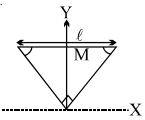
The figure shows an isosceles triangular plate of mass $M$ and base $L$. The angle at the apex is $90^o$. The apex lies at the origin and the base is parallel to $X$ -axis The moment of inertia of the plate about the $x$ -axis is
A car runs at a constant speed on a circular track of radius $100\,m$ , taking $62.8\,sec$ for every circular lap. The average velocity and average speed for each circular lap respectively is 
A sinusoidal voltage of peak value $283\, V$ and angular frequency $320/s$ is applied to a series $LCR$ circuit. Given that $R\, = 5\,\Omega $ , $L\,= 25\, mH$ and $C\, = 1000\, \mu F$. The total impedance, and phase difference between the voltage across the source and the current will respectively be
A convex mirror of focal length $10\,cm$ is shown in figure. A linear object $AB = 5\,cm$ is placed along the optical axis. Point $B$ is at distance $20\,cm$ from the pole of mirror. Then size of image of $AB$ will be
A cylindrical vessel of cross-section $A$ contains water to a height $h$ . There is a hole in the bottom of radius $'a'$ . The time in which it will be emptied is
There exists an electric field of magnitude $E$ in $x$-direction. If the work done in moving a charge of $0.2 \,C$ through a distance of $2 \,m$ along a line making an angle $60^{\circ}$ with $x$-axis is $4 \,J$, then the value of $E$ is ........ $N / C$
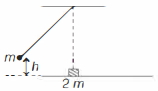
A ball of mass $m$ suspended from a rigid support by an inextensible massless string is released from a height $h$ above its lowest point. At its lowest point, it collides elastically with a block of mass $2 m$ at rest on a frictionless surface. Neglect the dimensions of the ball and the block. After the collision, the ball rises to a maximum height of