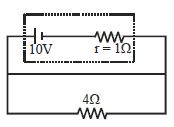
Potential difference across the terminals of the battery shown in figure is .................... $V$ ($r =$ internal resistance of battery)
Medium
Download our app for free and get started
As battery is short circuited
$\mathrm{I}=\frac{\mathrm{E}}{r}=\frac{10}{1}=10 \mathrm{A}$
$v=E-I r$
$V=10-10 \times 1$
$V=0$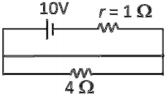

Download our appand get started for free
Experience the future of education. Simply download our apps or reach out to us for more information. Let's shape the future of learning together!No signup needed.*
Similar Questions
- 1View SolutionThe drift velocity does not depend upon
- 2A voltmeter having a resistance of $998\, ohms$ is connected to a cell of $e.m.f.$ $2\, volt$ and internal resistance $2\, ohm$. The error in the measurement of $e.m.f.$ will beView Solution
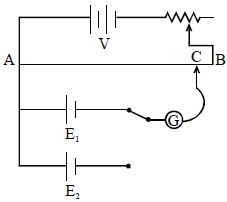
- 3The circuit shown here is used to compare the emf of two cells $E_1$ and $E_2 (E_1 > E_2)$. The null point is at $C$ when the galvanometer is connected to $E_1$. When the galvanometer is connected to $E_2$, the null point will beView Solution
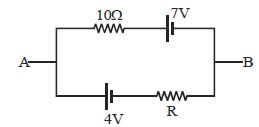
- 4In the following circuit if $V_A -V_B = 6\,V$ then the value of resistance $R$ (in $ohm$) is ............... $\Omega$View Solution
- 5Two cells, having the same $e.m.f.$ are connected in series through an external resistance $R.$ Cells have internal resistances $r_1$ and $r_2\,\, (r_1 > r_2)$ respectively. When the circuit is closed, the potential difference across the first cell is zero. The value of $R$ isView Solution
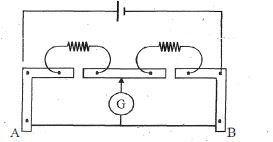
- 6A meter bridge set up as shown to determine end correction at $A$ and $B$ . When a resistance of $15\,\Omega $ is used in left gap and of $20\,\Omega $ in right gap, then null point comes at a distance $42\ cm$ from $A$ . When these resistances are interchanged null point comes at a distance $57\ cm$ from $A$ . Values of end corrections areView Solution
- 7The electric bulbs have tungsten filaments of same length. If one of them gives $60 \,watt$ and other $100\, watt$, thenView Solution
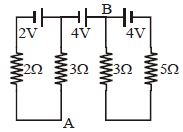
- 8In the given circuit calculate potential difference between $A$ and $B$ ............... $\mathrm{V}$View Solution
- 9A cell of internal resistance $3\, ohm$ and $emf$ $10\, volt$ is connected to a uniform wire of length $500 \,cm$ and resistance $3\, ohm$. The potential gradient in the wire is .............. $mV/cm$View Solution
- 10An electric iron draws $5\, amp$, a $TV$ set draws $3\, amp$ and refrigerator draws $2\, amp$ from a $220\, volt$ main line. The three appliances are connected in parallel. If all the three are operating at the same time, the fuse used may be of ............. $amp$View Solution