MCQ
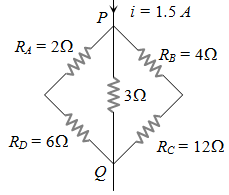
Potential difference between the points $P$ and $Q$ in the electric circuit shown is
  • A
    $4.5 V$
  • B
    $1.2 V$
  • C
    $2.4 V$
  • $2.88 V$

Answer

Correct option: D.
$2.88 V$
$2.88 V$

Need a full question paper?

Generate a complete, print-ready paper with questions like this in minutes — across 16+ boards, with answer keys.

Start Generating Free

Similar questions

The relation between the drift velocity $ (V_d) $ and applied electric field $ (E) $ of a conductor is :
Ten capacitor are joined in parallel and charged with a battery up to a potential V. They are then disconnected from battery and joined again in series then the potential of this combination will be(a) V (b) 10V(c) 5V   (d) 2V
       
What should be the angle between two plane mirrors so that whatever be the angle of incidence, the incident ray and the reflected ray from the two mirrors be parallel to each other(a) 60°(b) 90°(c) 120°(d) 175°
       
The value of $\frac{1}{4\pi\in_{0}}$
The magnetic dipole moment of a current carrying coil does not depend upon:
A block is placed on a rough floor and a horizontal force F is applied on it. The force of friction f by the floor on the block is measured for different values of F and a graph is plotted between them.
  1. The graph is a straight line of slope 45°.
  2. The graph is a straight line parallel to the F-axis.
  3. The graph is a straight line of slope 45° for small F and a straight line parallel to the F-axis for large F.
  4. There is a small kink on the graph.
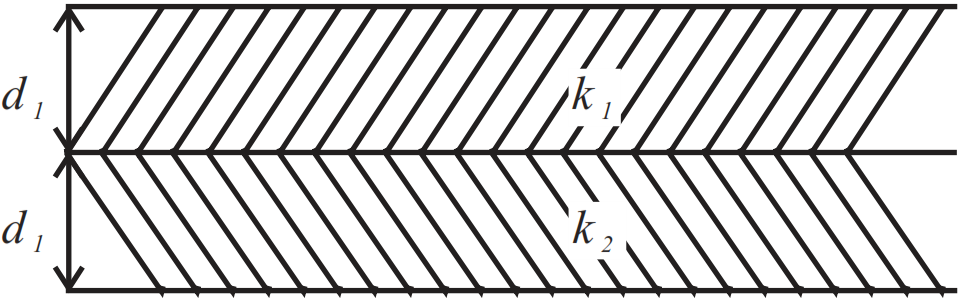
A parallel plate capacitor is made of two dielectric blocks in series. One of the blocks has thickness $d_1$ and dielectric constant $k_1$ and the other has thickness $d_2$ and dielectric constant $k_2$ as shown in Fig.

This arrangement can be thought as a dielectric slab of thickness $d (= d_1 + d_2)$ and effective dielectric constant $k$. The $k$ is
Among the following one can act as the building blocks for the other gates is:
Choose the wrong statement of the following:
A concave lens of focal length 20 cm placed in contact with a plane mirror acts as a(a) Convex mirror of focal length 10 cm(b) Concave mirror of focal length 40 cm(c) Concave mirror of focal length 60 cm(d) Concave mirror of focal length 10 cm