MCQ
Potential energy of a charged conductor is :
- A$ CV^2 $
- ✓$ \frac{1}{2} CV^2 $
- C$ \frac{1}{3} CV^2 $
- D$ \frac{1}{4} CV^2 $
Generate a complete, print-ready paper with questions like this in minutes — across 16+ boards, with answer keys.
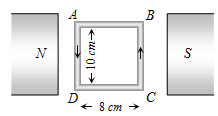
A 100 turns coil shown in figure carries a current of 2 amp in a magnetic field  . The torque acting on the coil is
|
(a) 0.32 Nm tending to rotate the side AD out of the page |
|
(b) 0.32 Nm tending to rotate the side AD into the page |
|
(c) 0.0032 Nm tending to rotate the side AD out of the page |
|
(d) 0.0032 Nm tending to rotate the side AD into the page |
The frequencies of X-rays, g-rays and ultraviolet rays are respectively a, b and c. Then
|
(a) a < b, b > c |
(b) a > b, b > c |
(c) a > b, b < c |
(d) a < b, b < c |
In hydrogen atom, the electron makes 6.6  revolutions per second around the nucleus in an orbit of radius 0.5
  . It is equivalent to a current nearly
|
(a) 1 A |
(b) 1 mA |
(c) 1 μA |
(d) 1.6 |
The potential energy of a particle of mass m is given by
U(x) = 
l1 and l2 are the de-Broglie wavelengths of the particle, when 0 £ x £ 1 and x > 1 respectively. If the total energy of particle is 2E0, the ratio  will be
|
(a) 2 |
(b) 1 |
(c) |
(d) |
In a transformer, number of turns in the primary are 140 and that in the secondary are 280. If current in primary is 4A then that in the secondary is
|
(a) 4 A |
(b) 2 A |
(c) 6 A |
(d) 10 A |
In human eye the focussing is done by
|
(a) To and fro movement of eye lens |
|
(b) To and fro movement of the retina |
|
(c) Change in the convexity of the lens surface |
|
(d) Change in the refractive index of the eye fluids |
If the threshold wavelength for sodium is 5420 Å, then the work function of sodium is
|
(a) 4.58 eV |
(b) 2.28 eV |
(c) 1.14 eV |
(d) 0.23 eV |


