MCQ
Potential energy of a person is minimum when:
  • A
    Person is standing.
  • B
    Person is sitting on a chair.
  • C
    Person is sitting on the ground.
  • D
    Person is lying on the ground.

Answer

  1. Person is lying on the ground.

Explanation:

Potential energy of a body is defined as energy of a body due to its position in gravitational field.

In general, Potential energy = M × g × h where: h is the height above ground.

If the person will be lying on ground then it will have minimum height above the ground therefore potential energy of the person will also be minimum.

Need a full question paper?

Generate a complete, print-ready paper with questions like this in minutes — across 16+ boards, with answer keys.
Start Generating Free

Similar questions

A body thrown vertically up from the ground passes the height 10.2m twice at an interval of 10s. What was its initial velocity? (in m/ s)
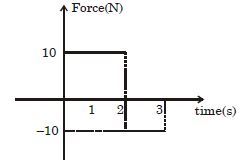
A $2\ kg$ object is floating at rest, acted upon by only force as indicated in figure. Find the total work done by the force in $3\ sec$ ..................... $\mathrm{J}$
For inelastic collision between two spherical rigid bodies
Two water pipes $P$ and $Q$ having diameter $2 \times 10^{-2} \,m$ and $4 \times 10^{-2} \,m$ respectively are joined in series with the main supply line of water. The velocity of water flowing in pipe $P$ is ........
$P_i, V_i$ and $P_f$, $V_f$ are initial and final pressures and volumes of a gas in a thermodynamic process respectively. If $PV^n =$ constant, then the amount of work done is 
The temperature of food material in refrigerator is $4^{\circ} C$ and temperature of environment is $15^{\circ} C$. If carnot cycle is used in its working gas, then find its carnot efficiency.
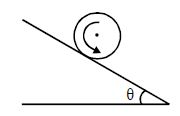
A disc is given angular velocity ${\omega _0}$ as shown in figure and kept on an inclined plane of inclination $\theta $ having coefficient of friction $\mu$ = $tan \theta $ . The initial acceleration of centre of mass is $a$ and angular acceleration $\alpha $ , then
A spherical ball of density $\rho$ and radius $0.003$ $m$ is dropped into a tube containing a viscous fluid filled up to the $0$ $ cm$ mark as shown in the figure. Viscosity of the fluid $=$ $1.260$ $N.m^{-2}$ and its density $\rho_L=\rho/2$ $=$ $1260$ $kg.m^{-3}$. Assume the ball reaches a terminal speed by the $10$ $cm$ mark. The time taken by the ball to traverse the distance between the $10$ $cm$ and $20$ $cm$ mark is

( $g$ $ =$ acceleration due to gravity $= 10$ $ ms^{^{-2}} )$

A body is thrown vertically upwards. Which one of the following graphs correctly represent the velocity vs time?
Two stones are projected so as to reach the same distance from the point of projection on a horizontal surface. The maximum height reached by one exceeds the other by an amount equal to half the sum of the height attained by them. Then, angle of projection of the stone which attains smaller height is $........$