Question

Potential gradient is defined as

(a) Fall of potential per unit length of the wire

(b) Fall of potential per unit area of the wire

(b) Fall of potential per unit area of the wire

(d) Potential at any one end of the wire

Answer

(a) Fall of potential per unit length of the wire

Need a full question paper?

Generate a complete, print-ready paper with questions like this in minutes — across 16+ boards, with answer keys.

Start Generating Free

Similar questions

The resultant capacitance of given circuit is

(a) 3C

(b)  2C

(c) C

(d)  

Which of the following electromagnetic waves is used in medicine to destroy cancer cells?

Light of wavelength  strikes a photo-sensitive surface and electrons are ejected with kinetic energy E. If  the kinetic energy is to be increased to 2E, the wavelength must be changed to   where

(a)  

(b)  

(c)  <

(d)  

Nuclear fission was discovered by

(a) Auto Hahn and F. strassmann

(b) Fermi

(c) Bethe

(d) Rutherford

The potential difference across the 100 W resistance in the following circuit is measured by a voltmeter of 900 W resistance. The percentage error made in reading the potential difference is

(a)  

(b) 0.1

(c) 1.0

(d) 10.0

A) Line spectra is due to atoms in gaseous state:
B) Band spectra is due to molecules:

The resistivity of a wire depends on its

(a) Length

(b) Area of cross-section

(c) Shape

(d) Material

Biot-Savart law indicates that the moving electrons (velocity v) produce a magnetic field B such that:

The electromagnetic waves of frequency 2 MHz to 30 MHz are

(a) In ground wave propagation

(b) In sky wave propagation

(c) In microwave propagation

(d) In satellite communication

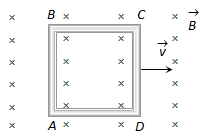
A conducting square loop of side L and resistance R moves in its plane with a uniform velocity v perpendicular to one of its sides. A magnetic induction B constant in time and space, pointing perpendicular and into the plane of the loop exists everywhere. The current induced in the loop is

(a)  clockwise

(b) anticlockwise

(c) anticlockwise

(d) Zero