MCQ
 Potentiometer measures potential more accurately because
  • A
    it measures potential in the open circuit.
  • B
    it uses sensitive galvanometer for null deflection.
  • C
    it uses high resistance potentiometer wire.
  • D
    it measures potential in the closed circuit.

Answer

  1. it measures potential in the open circuit.

Explanation:

A potentiometer has very large resistance. To read load voltage or voltage across any circuit element, potentiometer is connected parallel across it. Thus, the load voltage or circuit voltage gets applied across the potentiometer but as the resistance is very high compared to load resistance, you can safely assume their is almost no current flowing through potentiometer. As power = VI, the power loss in potentiometer is almost equal to zero as current through it remains zero.

Need a full question paper?

Generate a complete, print-ready paper with questions like this in minutes — across 16+ boards, with answer keys.

Start Generating Free

Similar questions

Using a bar magnet P, a vibration magnetometer has time  period 2seconds. When a bar Q (identical to P in mass and size) is placed on top of P, the time period is unchanged. Which of the following statements is true

(a) Q is of non-magnetic material

(b) Q is a bar magnet identical to P, and its north pole placed on top of P's north pole

(c) Q is of unmagnetized ferromagnetic material

(d) Nothing can be said about Q's properties

A particle with   of charge and   mass is moving with a velocity of   along the y-axis. A uniform static magnetic field B = 0.5 Tesla  is acting along the x-direction. The force on the particle is

(a) 5 ×   along  

(b) 5   along  

(c)  5 ×  along - 

(d) 5   along  - 

There is a small hole near the bottom of an open tank filled with a liquid. The speed of the water ejected does not depend on.
  1. Area of the hole.
  2. Density of the liquid.
  3. Height of the liquid from the hole.
  4. Acceleration due to gravity.

A circular coil ‘A’ has a radius R and the current flowing through it is I. Another circular coil ‘B’ has a radius 2R and if 2I is the current flowing through it, then the magnetic fields at the centre of the circular coil are in the ratio of (i.e.   to )

(a) 4 : 1   

(b) 2 : 1

(c) 3 : 1    

(d) 1 : 1

The momentum of photon is :
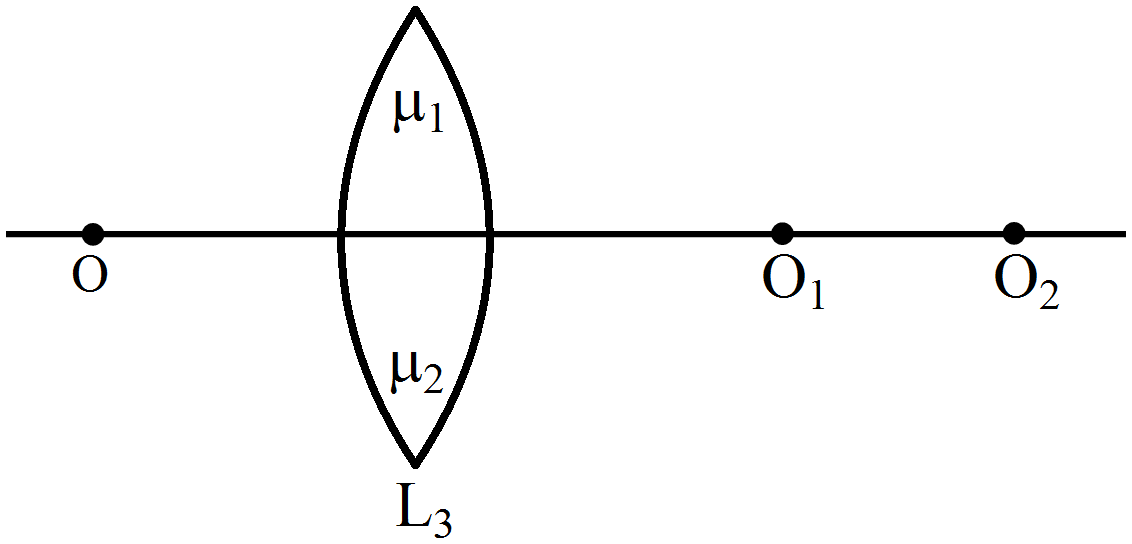
Consider three converging lenses L1, L2 and L3 having identical geometrical construction. The index of refraction of L1 and L2 are $\mu_1$ and $\mu_2$ respectively. The upper half of the lens L3 has a refractive index $\mu_1$ and the lower half has $\mu_2$. A point object O is imaged at O1 by the lens L1 and at O2 by the lens L2 placed in same position. If L3 is placed at the same place:

  1. There will be an image at O1
  2. There will be an image at O2
  3. The only image will form somewhere between O1 and O2
  4. The only image will form away from O2.

Which of the following wavelength falls in X-ray region

(a) 10000 Å

(b) 1000 Å

(c) 1 Å

(d) 10–2 Å

Permanent magnets should have:

A double convex lens ( having focal length equal to the focal length of a concave mirror. The radius of curvature of the concave mirror is

(a) 10 cm

(b) 20 cm

(c) 40 cm

(d) 15 cm

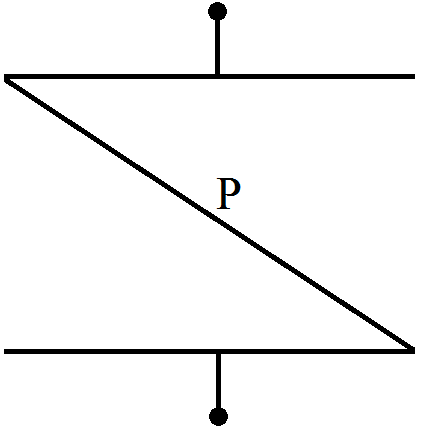
A thin metal plate P is inserted between the plates of a parallel-plate capacitor of capacitance C in such a way that its edges touch the two plates (figure). The capacitance now becomes: