Question
Power delivered by the source of the circuit becomes maximum, when

Answer

As we know,

power delivered by the source of the circuit becomes maximum when, load resistance equals to source resistance.

we know, in $L-C-R$ circuit,

load resistance is inductive reactance and source resistance is reactance of capacitor.

$\text { e.g., } X_L=X_C$

or, $\omega L =\frac{1}{\omega C }$

hence, Power delivered by the source of the circuit becomes maximum, when,

$\omega L =\frac{1}{\omega C }$

Need a full question paper?

Generate a complete, print-ready paper with questions like this in minutes — across 16+ boards, with answer keys.
Start Generating Free

Similar questions

Liquids have no Poisson's ratio, because
If $\vec{a}$ and $\vec{b}$ makes an angle $\cos ^{-1}\left(\frac{5}{9}\right)$ with each other, then $|\vec{a}+\vec{b}|=\sqrt{2}|\vec{a}-\vec{b}|$ for $|\vec{a}|=n|\vec{b}|$ The integer value of $n$ is . . . . . . .. 
What is the power gain in a $CE$ amplifier, where input resistance is $3 \,k \Omega$ and load resistance $24 \,k \Omega$ given $\beta=6 ?$
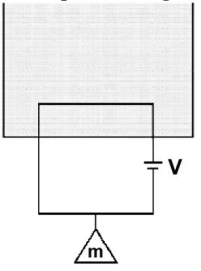
A massless square loop, of wire of resistance $10\,\Omega$. supporting a mass of $1\,g$. hangs vertically with one of its sides in a uniform magnetic field of $10^3\, G$, directed outwards in the shaded region. A dc voltage $V$ is applied to the loop. For what value of V. the magnetic force will exactly balance the weight of the supporting mass of $1\,g$ ? (If sides of the loop $=10\,cm , g =10\,ms ^{-2}$ )
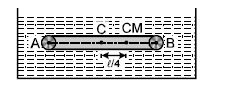
A non uniform cylinder of mass $m$ , length $l$ and radius $r$ is having its cetnre of mass at a distance $l/4$ from the centre and lying on the axis of the cylinder. The cylinder is kept in a liquid of uniform density $\rho $ . The moment of inertia of the rod about the centre of mass is $I$ . The angular acceleration of point $A$ relative to point $B$ just after the rod is released from the position shown in figure is
An electron, a proton and an alpha particle having the same kinetic energy are moving in circular orbits of radii $r_e,r_p$ and ${r_\alpha }$ respectively in a uniform magnetic field $B$. The relation between $r_e,r_p$ and $\;{r_\alpha }$ is
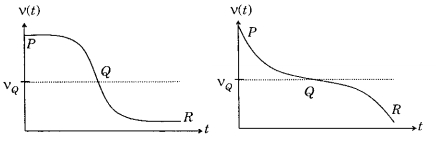
Two loudspeakers $M$ and $N$ are located $20 \mathrm{~m}$ apart and emit sound at frequencies $118 \mathrm{~Hz}$ and $121 \mathrm{~Hz}$, respectively. $A$ car is initially at a point $P, 1800 \mathrm{~m}$ away from the midpoint $Q$ of the line $M N$ and moves towards $Q$ constantly at $60 \mathrm{~km} / \mathrm{hr}$ along the perpendicular bisector of $M N$. It crosses $Q$ and eventually reaches a point $R, 1800(m$ away from $Q$. Let $v(t)$ represent the beat frequency measured by a person sitting in tlie car at time $t$. Let $v_P, v_Q$ and $v_R$ be the beat frequencies measured at locations $P . Q$ and $R$, respectively. The speed of sound in air is $330 \mathrm{~m} \mathrm{~s}^{-1}$. Which of the following statement($s$) is(are) true regarding the sound heard by the person?

($A$) $v_P+v_R=2 v_Q$

($B$) The rate of change in beat frequency is maximum when the car passes through $Q$

($C$) The plot below represents schematically the variation of beat frequency with time

(image)

($D$) The plot below represents schematically the variation of beat frequency with time

(image)
The wavelength of $X-$ rays decreases, when
$1 \,mg$ gold undergoes decay with $2.7$ days half-life period, amount left after $8.1$ days is ......... $mg$
The resistor of resistance '$R$' is connected to $25\, V$ supply and heat produced in it is $25\, J/sec$. The value of $R$ is .......... $\Omega $