Predict all the alkenes that would be formed by dehydrohalogenation of the following halides with sodium ethoxide in ethanol and identify the major alkene:
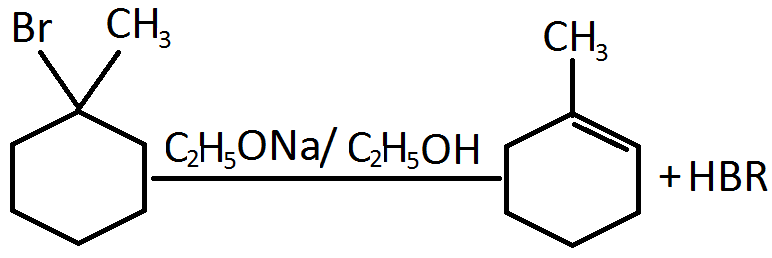
1-Bromo-1-methylcyclohexane
1-Bromo-1-methylcyclohexane
Download our app for free and get started
In 1-bromo-1-methylcyclohexane compound, all $\beta-\text{hydrogen}$ atoms are equivalent. Thus, dehydrohalogenation of this compound gives only one alkene.

Download our appand get started for free
Experience the future of education. Simply download our apps or reach out to us for more information. Let's shape the future of learning together!No signup needed.*
Similar Questions
- 1View SolutionGive reasons for the following:
Iodoform is obtained by reaction of acetone with hypoiodite ion but not iodide ion. - 2View SolutionDefine ambidient nucleophile with an example.
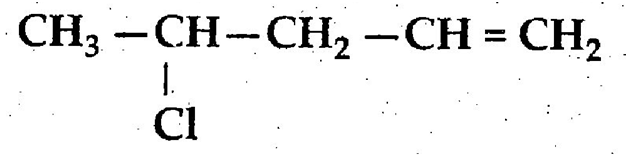
- 3View SolutionWrite the IUPAC name of.
- 4View SolutionHow the following conversion can be carried out?
But-1-ene to n-butyliodide. - 5View SolutionHow will you bring about the following conversion?
Propene to 1-nitropropane. - 6Answer the following questions: Arrange the following haloalkanes in the increasing order of density. Justify your answer. $\ce{CCl_4, CH_2Cl_2}$ and $\ce{CHCl_3}.$View Solution
- 7Read the given passage and answer the questions number $1$ to $5$ that follow:View Solution
The substitution reaction of alkyl halide mainly occurs by $S_N1$ or $S_N2$ mechanism. Whatever mechanism alkyl halides follow for the substitution reaction to occur, the polarity of the carbon halogen bond is responsible for these substitution reactions. The rate of $S_N1$ reactions are governed by the stability of carbocation whereas for $S_N2$ reactions steric factor is the deciding factor. If the starting material is a chiral compound, we may end up with an inverted product or racemic mixture depending upon the type of mechanism followed by alkyl halide. Cleavage of ethers with $HI$ is also governed by steric factor and stability of carbocation, which indicates that in organic chemistry, these two major factors help us in deciding the kind of product formed.
Predict the stereochemistry of the product formed if an optically active alkyl halide undergoes substitution reaction by $S_N1$ mechanism. - 8View SolutionWrite the structures of the following organic halogen compound.
1-Chloro-4-ethylcyclohexane - 9View SolutionGive reasons for the following: Thionyl chloride method is preferred for preparing alkyl chlorides from alcohols.
- 10View SolutionWhat do you understand by the term optical activity of compounds?