Question
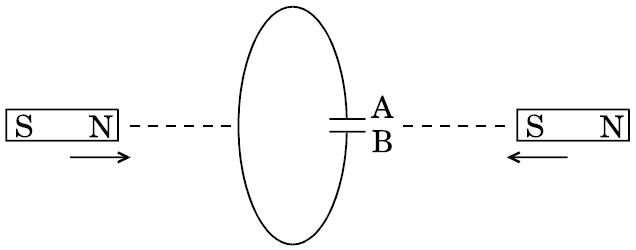
Predict the polarity of the capacitor in the situation described below:

Answer

A is positive and B is negative.

Need a full question paper?

Generate a complete, print-ready paper with questions like this in minutes — across 16+ boards, with answer keys.
Start Generating Free

Similar questions

A metal block of density $6000\ kg m^{-3}$ and mass $1.2\ kg$ is suspended through a spring of spring constant $200N m^{-1}$. The spring-block system is dipped in water kept in a vessel. The water has a mass of $260g$ and the block is at a height $40\ cm$ above the bottom of the vessel. If the support to the spring is broken, what will be the rise in the temperature of the water. Specific heat capacity of the block is $250J\ kg^{-1} K^{-1}$ and that of water is $4200J\ kg^{-1} K^{-1}$. Heat capacities of the vessel and the spring are negligible.
What happens to the width of depletion layer of a p-n junction when it is (i) forward biased, (ii) reverse biased?
What is the phase difference between any two points located on a wave front?
The motion of copper plate is damped when it is allowed to oscillate between the two poles of a magnet. What is the cause of this damping?
The polarising angle of a medium is 60°. What is the refractive index of the medium?
Carbon, silicon and germanium have four valence electrons each. These are characterised by valence and conduction bands separated by energy band gap respectively equal to $(E_g)_C, (E_g)_{si }$and $(E_g)_{Ge}.$ Which of the following statements is true?
A charged particle enters along the axis of a current carrying a long solenoid. How is its velocity affected? Will the particle be accelerated or decelerated?
Define work function for a given metallic surface.
What physical quantity is the same for X-rays of wavelength $10^{-10} m$, red light of wavelength 6800 Å and radio-waves of wavelength 500 m?
The free electrons in a conducting wire are in constant thermal motion. If such a wire, carrying no current, is placed in a magnetic field, is there a magnetic force on each free electron? On the wire?