Question
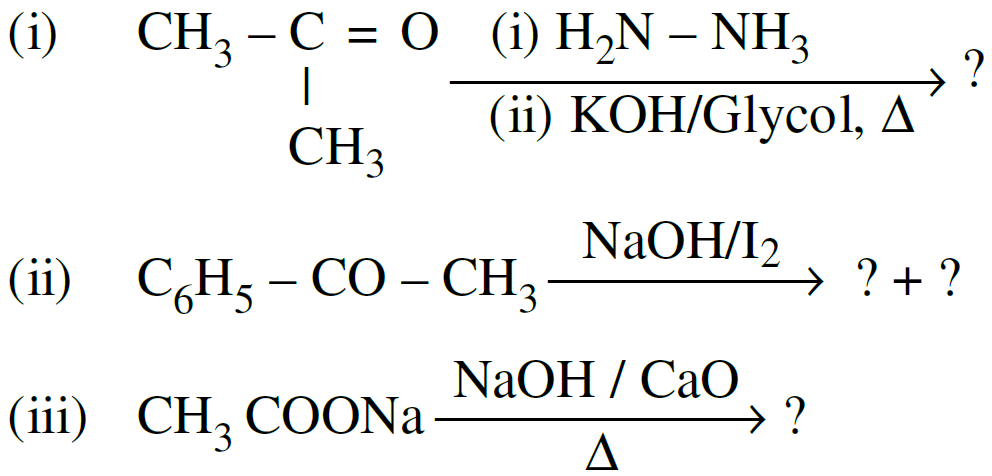
✓
Answer
- CH3CH2CH3.
- C6H5COONa+CHI3.
- CH4.
Need a full question paper?
Generate a complete, print-ready paper with questions like this in minutes — across 16+ boards, with answer keys.
Explore more
Similar questions
The electrical resistance of a column of 0.05 M KOH solution of diameter 1 cm and length 45·5 cm is 4.55 $\times$ 103 ohm. Calculate its molar conductivity.
→Give reasons:
- E° value for Mn3+/ Mn2+ couple is much more positive than that for Fe3+/ Fe2+.
- Iron has higher enthalpy of atomization than that of copper.
- Sc3+ is colourless in aqueous solution whereas Ti3+ is coloured.
Predict the order of reactivity of the following compounds in SN1 and SN2 reactions:
C6H5CH2Br, C6H5CH(C6H5)Br, C6H5CH(CH3)Br, C6H5C(CH3)(C6H5)Br.
C6H5CH2Br, C6H5CH(C6H5)Br, C6H5CH(CH3)Br, C6H5C(CH3)(C6H5)Br.
Match the example given in Column I with the name of the reaction in Column II.
| Column I (Example) |
| Column II (Reaction) |
(i) | $\ \ \ \ \ \ \ \ \ \ \ \ \ \text{O}\ \ \ \ \ \ \ \ \ \ \ \ \ \ \ \ \ \ \ \ \ \ \ \ \ \ \ \ \ \ \ \ \ \ \ \ \ \ \ \ \ \ \ \ \ \ \ \ \ \ \ \text{O}\\ \ \ \ \ \ \ \ \ \ \ \ \ \ || \ \ \ \ \ \ \ \ \ \ \ \ \ \ \ \ \ \ \ \ \ \ \ \ \ \ \ \ \ \ \ \ \ \ \ \ \ \ \ \ \ \ \ \ \ \ \ \ \ \ \ \ ||\\\text{CH}_3-\text{C}-\text{Cl}+\text{H}_2\xrightarrow{\text{Pd-C/BaSO}_4}\text{CH}_3-\text{C}-\text{H}$ | (a) | Friedel Crafts acylation |
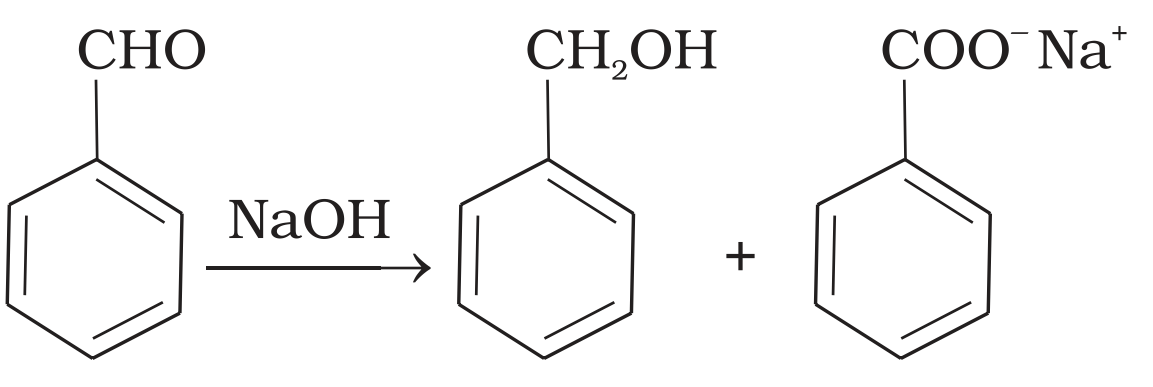
(ii) |
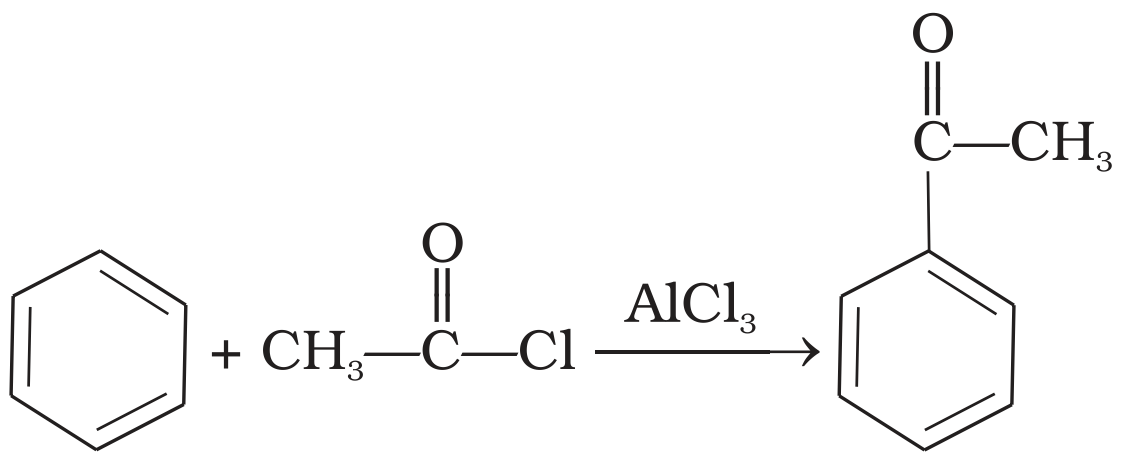
| (b) | HVZ reaction |
(iii) |
| (c) | Aldol condensation |
(iv) | $\text{R}-\text{CH}_2-\text{COOH}\xrightarrow{\text{Br}_2/\text{Red}\ \text{P}}\text{R}-\text{CH}-\text{COOH}\\ \ \ \ \ \ \ \ \ \ \ \ \ \ \ \ \ \ \ \ \ \ \ \ \ \ \ \ \ \ \ \ \ \ \ \ \ \ \ \ \ \ \ \ \ \ \ \ \ \ \ \ \ \ \ \ \ \ \ \ \ \ \ \ \ \ \ \ |\\\ \ \ \ \ \ \ \ \ \ \ \ \ \ \ \ \ \ \ \ \ \ \ \ \ \ \ \ \ \ \ \ \ \ \ \ \ \ \ \ \ \ \ \ \ \ \ \ \ \ \ \ \ \ \ \ \ \ \ \ \ \ \ \ \ \ ^\text{Br}$ | (d) | Cannizaro’s reaction |
(v) | $\text{CH}_3-\text{CN}\xrightarrow[\text{(ii)}\ \text{H}_2\text{O}/\text{H}^+]{\text{(i)}\ \text{SnCl}_2/\ \text{HCl}}\text{CH}_3\text{CHO}$ | (e) | Rosenmund’s reduction |
(vi) | $2\text{CH}_3\text{CHO}\xrightarrow{\text{NaOH}}\text{CH}_3-\text{CH}=\text{CH}=\text{CHCHO}$ | (f) | Stephen’s reaction |
Vapour pressure of water at 293 K is 17.535 mm Hg. Calculate the vapour pressure of water at 293 K when 25 g of glucose is dissolved in 450 g of water.
- How would you account for the following:
- Actinoid contraction is greater than lanthanoid contraction.
- Transition metals form coloured compounds.
- Complete the following equation:
$\text{2MnO}_{4}^{-}+\text{6H}^{+}+\text{5NO}_{2}^{-}\rightarrow$
- What type of isomerism is shown by the complex [Co(NH3)5 (SCN)]2+?
- Why is [NiCl4]2- paramagnetic while [Ni(CN)4]2- is diamagnetic? (Atomic number of Ni = 28)
- Why are low spin tetrahedral complexes rarely observed?
Name the following coordination entities and draw the structures of their stereoisomers:
- [Co(en)2Cl2]+ (en = ethan-l, 2-diamine).
- [Cr(C2O4)3]3–.
- [Co(NH3)3 Cl3].
Calculate the standard cell potentials of galvanic cell in which the following reactions take place:
Fe2+(aq) + Ag+ (aq) → Fe3+(aq) + Ag(s)
Calculate the $\triangle_\text{r}\text{G}^\ominus$ and equilibrium constant of the reactions.
→Fe2+(aq) + Ag+ (aq) → Fe3+(aq) + Ag(s)
Calculate the $\triangle_\text{r}\text{G}^\ominus$ and equilibrium constant of the reactions.
The halides of transition elements become more covalent with increasing oxidation state of the metal.