MCQ
Primary and secondary amines can be distinguished by
  • A
    Hoffmann's mustard oil reaction
  • B
    carbylamine reaction
  • C
    Hinsberg reagent
  • All

Answer

Correct option: D.
All
d

Need a full question paper?

Generate a complete, print-ready paper with questions like this in minutes — across 16+ boards, with answer keys.
Start Generating Free

Similar questions

Selenium has the unusual property of being a good conductor in light but a poor conductor in the dark. It was, therefore, used in making.
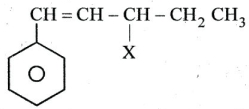
The given compound is an example of $..........$
Hoffmann bromomide degradation of benzamide gives product $A$, which upon heating with $CHCl _{3}$ and $NaOH$ gives product $B$. The structures of $A$ and $B$ are
Which of the following compound will form $2^o -$ alcohol when treated with Grignard reagent followed by hydrolysis
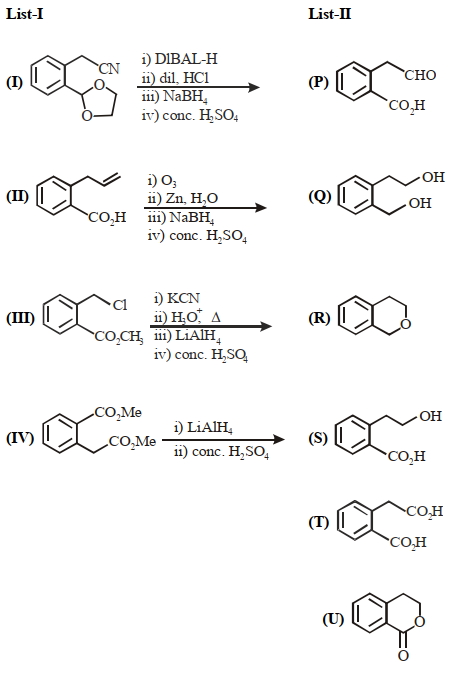
Answer the following by appropriately matching the lists based on the information given in the paragraph $List-I$ includess starting materials and reagents of selected chemical reactions. $List-II$ gives structures of compounds that may be formed as intermediate products and/or final products from the reactions of $List-I$

($1$) Which of the following options has correct combination considering $List-I$ and $List-II$?

$(1) (III), (S), (R)$ $(2) (IV), (Q), (R)$ $(3) (III), (T), (U)$ $(4) (IV), (Q), (U)$

($2$) Which of the following options has correct combination considering $List-I$ and $List-II$?

$(1) (I), (Q), (T), (U)$ $(2) (II), (P), (S), (U)$ $(3) (II), (P), (S), (T)$ $(4) (I), (S), (Q), (R)$

Give the answer quetion ($1$) and ($2$)

Which will undergo deprotonation most readily in basic medium?
Match List $I$ with List $II$

List $I$ (Coordination entity) List $II$ (Wavelength of light absorbed in $nm$)
$A$ ${\left[ CoCl \left( NH _3\right)_5\right]^{2+}}$ $I$ $310$
$B$ ${\left[ Co \left( NH _3\right)_6\right]^{3+}}$ $II$ $475$
$C$ ${\left[ Co ( CN )_6\right]^{3-}}$ $III$ $535$
$D$ ${\left[ Cu \left( H _2 O \right)_4\right]^{2+}}$ $IV$ $600$

Choose the correct answer from the options given below

What is the mole fraction of the solute in $2.5\,m$ aqueous solution
$3.65\,gms$ of $HCl$ is dissolved in  $16.2\,gms$ of water. The mole fraction of $HCl$  in the resulting solution is
An alcohol having molecular weight $74$ gives white turbidity with Lucas reagent within $5-10$ minutes. It reacts with sodium metal to give $Y. Y$ reacts with $CH_3-Br$ to give $Z$. $Z$ is :