MCQ
Primary nitro compounds when react with $HN{O_2}$ forms crystalline solids which on treatment with $NaOH$ gives
- ✓Red solution
- BBlue solution
- CWhite precipitate
- DYellow colouration
Generate a complete, print-ready paper with questions like this in minutes — across 16+ boards, with answer keys.
$(I)\,[Xe]\, 6s^1$ $(II)\,[Xe]\,4f^{14}\,5d^1\,6s^2$
$(III)\,[Ar]\,4s^2\,4p^5$ $(IV)\,[Ar]\,3d^7,\,4s^2$
Select the incorrect statement about these elements
Statement $(I)$ : $p-$nitrophenol is more acidic than $m-$nitrophenol and $o-$nitrophenol.
Statement $(II)$ : Ethanol will give immediate turbidity with Lucas reagent.
In the light of the above statements, choose the correct answer from the options given below :
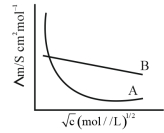
$(A)$ $\Lambda \stackrel{0}{ m }$ for electrolyte $A$ is obtained by extrapolation
$(B)$ For electrolyte B, vx $\Lambda m$ vs $\sqrt{ c }$ graph is a straight line with intercept equal to $\Lambda \stackrel{0}{ m }$
$(C)$ At infinite dilution, the value of degree of dissociation approach zero for electrolyte $B$.
$(D)$ $\Lambda \stackrel{0}{ m }$ for any electrolyte $A$ or $B$ can be calculated using $\lambda^{\circ}$ for individual ions.