MCQ
prism can produce a minimum deviation $\delta$ in a light beam. If three such prisms are combined, the minimum deviation that can be produced in this beam is:
  • A
    $0$
  • $\delta$
  • C
    $2\delta$
  • D
    $3\delta$

Answer

Correct option: B.
$\delta$

In combination $($refractive angles of prisms reversed with respect to each other$)$, the deviations through two prisms cancel out each other and the net deviation is due to the third prism only.

Need a full question paper?

Generate a complete, print-ready paper with questions like this in minutes — across 16+ boards, with answer keys.

Start Generating Free

Similar questions

Three capacitors of $2\,\mu F,\,3\,\mu F$ and $6\,\mu F$ are joined in series and the combination is charged by means of a $24\, volt$ battery. The potential difference between the plates of the $6\,\mu F$ capacitor is.......$volt$
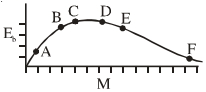
The above is a plot of binding energy per nucleon $E_b$, against the nuclear mass $M; A, B, C, D, E, F$ correspond to different nuclei. Consider four reactions

$(i)\;A+B\;\to\; C \;+\;\varepsilon $

$(ii)\;C\;\to \;A\;+\;B\;+\;\varepsilon $

$(iii)\;D\;+\;E\;\to \; F\;+$$\;\varepsilon $

$(iv)\;F\;\to \; D\;+\;E\;+\;\varepsilon $

$\;\varepsilon $  is the energy released? In which reactions is $\;\varepsilon $ positive?
The wavelength of sodium light in air is $5890 Å$. The velocity of light in air is $3 \times {10^8}m{s^{ - 1}}.$ The wavelength of light in a glass of refractive index $1.6$ would be close to......$\mathop A\limits^o $
Two waves of equal amplitude and frequency interfere each other. The ratio of intensity when the two waves arrive in phase to that when they arrive $90^\circ $ out of phase is
Diode is used as a/an
A crystal diode is a
At a specific instant emission of radioactive compound is deflected in a magnetic field. The compound can emit

$(i)$ Electrons              $(ii)$ Protons                 $(iii)$ $H{e^{2 + }}$                  $(iv)$ Neutrons

The emission at the instant can be
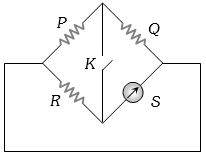
In the following Wheatstone bridge $P/Q = R/S$. If key $K$ is closed, then the galvanometer will show deflection
Eight dipoles of charges of magnitude $e$ are placed inside a cube. The total electric flux coming out of the cube will be
If mass$-$energy equivalence is taken into account, when water is cooled to form ice, the mass of water should: