MCQ
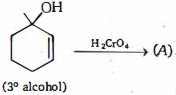
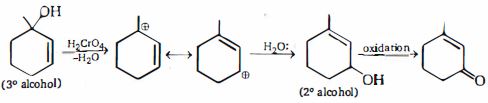
Product $(A)$ is
- ANo reaction
- ✓

- C

- D

Generate a complete, print-ready paper with questions like this in minutes — across 16+ boards, with answer keys.
$(i)\, [Co(NH_3)_5(NO_2 )]Cl_2$ and $[Co(NH_3)_5(ONO) ]Cl_2$ .... (Linkage)
$(ii)\, [Cu (NH_3)_4 ] [PtCl_4]$ and $[Pt(NH_3)_4] [CuCl_4]$ .... (Coordination)
$(iii)\, [PtCl_2 (NH_3)_4] Br_2$ and $[PtBr_2(NH_3)_4]Cl_2$ .... (Ionization)
Select the correct answer using the codes given below
Reason: Due to formation of a complex
$\left\{ en = H _2 NCH _2 CH _2 NH _2\right.$; atomic numbers: $\left.Ti =22 ; Cr =24 ; Cp =27 ; Pt =78\right\}$
| List-$I$ | List-$II$ |
| $P.$ $\left[ Cr \left( NH _3\right)_4 Cl _2\right) Cl ]$ | $1.$ Paramagnetic and exhibits ionisation isomerism |
| $Q.$ $\left[ Ti \left( H _2 O \right)_5 Cl \right]\left( NO _3\right)_2$ | $2.$ Diamagentic and exhibits cis-trans isomerism |
| $R.$ $\left[ Pt ( en )\left( NH _3\right) Cl \right] NO _3$ | $3.$ Paramagentic and exhibits cis-trans isomerism |
| $S.$ $\left[ Co \left( NH _3\right)_4\left( NO _3\right)_2\right] NO _3$ | $4.$ Diamagentic and exhibits ionisation isomerism |
Codes: $ \quad P \quad Q \quad R \quad S $