MCQ
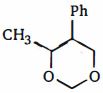
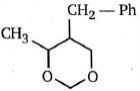
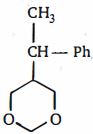
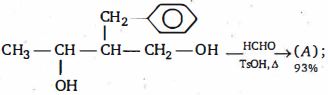
Product $(A)$ is
  • A


  • C

  • D

Answer

Correct option: B.

b
$(b)$ Nucleophilic addition then hemiacetal will form, which will again undergo  nucleophilic attack.

Need a full question paper?

Generate a complete, print-ready paper with questions like this in minutes — across 16+ boards, with answer keys.

Start Generating Free

Similar questions

 on reaction with $HBr$ gives
The time for half life period of a certain reaction $A \rightarrow$ Products is $1$ hour. When the initial concentration of the reactant $'A',$ is $2.0\, mol\, L^{-1},$ ....... $hr$ does it take for its concentration to come from $0.50$ to $0.25\, mol\, L^{-1}$ if it is a zero order reaction ?
In the following reaction sequence

$CH_3CH_2OH$ $\xrightarrow{{P + {I_2}}}A\xrightarrow[{{\text{dry ether}}}]{{Mg}}B\xrightarrow{{HCHO}}C\xrightarrow{{{H_2}O}}D$ the compound $D$ is

An electrolytic cell contains a solution of $A{g_2}S{O_4}$ and have platinum electrodes. A current is passed until $1.6\,gm$ of ${O_2}$ has been liberated at anode. The amount of silver deposited at cathode would be ............. $\mathrm{gm}$
Match the reactions (in the given stoichiometry of the reactants) in List-$I$ with one of their products given in List-$II$ and choose the correct option.

List-$I$ List-$II$
$\mathrm{P}_2 \mathrm{O}_3+3 \mathrm{H}_2 \mathrm{O} \rightarrow$ $\mathrm{P}(\mathrm{O})\left(\mathrm{OCH}_3\right) \mathrm{Cl}_2$
$\mathrm{P}_4+3 \mathrm{NaOH}+3 \mathrm{H}_2 \mathrm{O} \rightarrow$ $\mathrm{H}_3 \mathrm{PO}_3$
$\mathrm{PCl}_5+\mathrm{CH}_3 \mathrm{COOH} \rightarrow$ $\mathrm{PH}_3$
$\mathrm{H}_3 \mathrm{PO}_2+2 \mathrm{H}_2 \mathrm{O}+4 \mathrm{AgNO}_3 \rightarrow$ $\mathrm{H}_3 \mathrm{PO}_4$


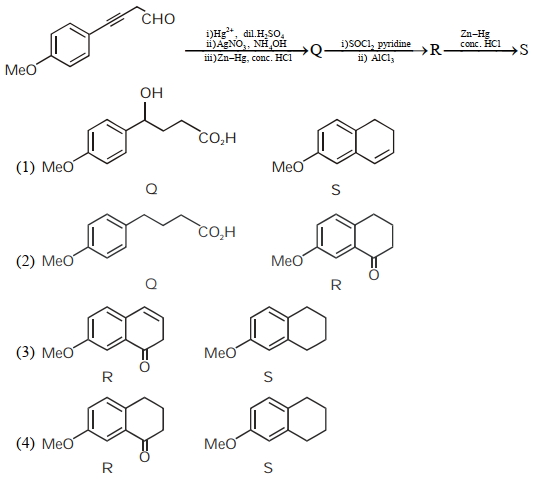
Choose the correct option($s$) for the following reaction sequence Consider $Q, R$ and $S$ as major products
Which one of the following species does not represent cationic species of vanadium formed in aqueous solution
Oxidation state of $Fe$  in ${K_3}[Fe{(CN)_6}]$
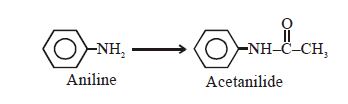
All but one of the following compounds react with Aniline to give acetanilide which one does not ?
The most common lanthanide is