MCQ
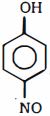
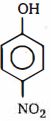
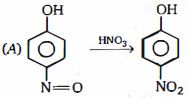
Product $(A)$ is
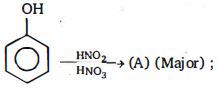
  • A

  • B


  • D

Answer

Correct option: C.

c
$(c)$ In presence of $HNO_3$ oxidation take place.

Need a full question paper?

Generate a complete, print-ready paper with questions like this in minutes — across 16+ boards, with answer keys.

Start Generating Free

Similar questions

Optical and geometrical isomerism exhibited by

$(a)$ $[Co(en)_2Cl_2]Br$ 

$(b)$ $[Pt(NH_3)_2Cl_2Br_2]$

$(c)$ $[Co(en)_3]Cl_3$

$(d)$ $[Pt(NH_3)_4Cl_2]$

$(e)$ $[Pt(NH_3)_2Cl_2]$

Number of oxygen atoms present in chemical formula of fuming sulphuric acid is. . . . . 
Laughing gas is prepared by heating
An aqueous solution of hydrazine $\left( N _2 H _4\right)$ is electrochemically oxidized by $O _2$, thereby releasing chemical energy in the form of electrical energy. One of the products generated from the electrochemical reaction is $N _2( g )$.

Choose the correct statement($s$) about the above process

$(A)$ $OH ^{-}$ions react with $N _2 H _4$ at the anode to form $N _2( g )$ and water, releasing 4 electrons to the anode.

$(B)$ At the cathode, $N _2 H _4$ breaks to $N _2( g )$ and nascent hydrogen released at the electrode reacts with oxygen to form water.

$(C)$ At the cathode, molecular oxygen gets converted to $OH ^{-}$.

$(D)$ Oxides of nitrogen are major by-products of the electrochemical process.

When $0.01\,mole$ of sugar is dissolved in $100\,g$ of a solvent, the depression in freezing point is ${0.40\,^o}$. When $0.03\,mole$ of glucose is dissolved in $50\,g$ of the same solvent, the depression in freezing point will be .........$^oC$.
An aqueous solution of hydrochloric acid
The following ion shows colour not due to $d-d$ transistion.
$Cu^{2+}$ and $Cd^{2+}$ are disintiguished through formation of complex $[Cu(CN)_4]^{3-}$ and $[Cd(CN)_4]^{2-}$ , when $H_2S$ gas is passed
$CH_3OH$ and $C_2H_5OH$ may be distinguished chemically
What is the side product of soap industry?