MCQ
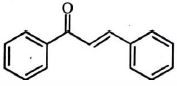
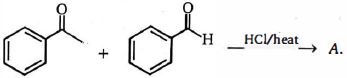
Product $( A)$ is
  • B
    $\begin{matrix}
       O\,\,\,\,\,\,\,\,\,\,\,\,\,\,\,\,\,\,\,\,\,\,\,\,\,\,\,\,\,\,\,\,\,\,\,\,  \\
       ||\,\,\,\,\,\,\,\,\,\,\,\,\,\,\,\,\,\,\,\,\,\,\,\,\,\,\,\,\,\,\,\,\,\,\,\,  \\
       Ph-C-C{{H}_{2}}-C{{H}_{2}}-Ph  \\
    \end{matrix}$
  • C
    $\begin{matrix}
       Ph-CH=CH-CH-Ph(d)  \\
       \,\,\,\,\,\,\,\,\,\,\,\,\,\,\,\,\,\,\,\,\,\,|  \\
       \,\,\,\,\,\,\,\,\,\,\,\,\,\,\,\,\,\,\,\,\,\,\,\,\,\,\,OH  \\
    \end{matrix}$
  • D
    $Ph - CH = C = CH - Ph$

Answer

Correct option: A.

a
$(a)$ Intermolecular Aldol condensation.

Need a full question paper?

Generate a complete, print-ready paper with questions like this in minutes — across 16+ boards, with answer keys.

Start Generating Free

Similar questions

In a protein molecule various amino acids are linked together by
Number of complexes from the following with even number of unpaired "$d$" electrons is  . . . . . . . . . .

${\left[\mathrm{V}\left(\mathrm{H}_2 \mathrm{O}\right)_6\right]^{3+}, \quad\left[\mathrm{Cr}\left(\mathrm{H}_2 \mathrm{O}\right)_6\right]^{2+}, \quad\left[\mathrm{Fe}\left(\mathrm{H}_2 \mathrm{O}\right)_6\right]^{3+},}$

${\left[\mathrm{Ni}\left(\mathrm{H}_2 \mathrm{O}\right)_6\right]^{3+},\left[\mathrm{Cu}\left(\mathrm{H}_2 \mathrm{O}\right)_6\right]^{2+}}$

[Given atomic numbers: $\mathrm{V}=23, \mathrm{Cr}=24, \mathrm{Fe}=26$,

$\mathrm{Ni}=28, \mathrm{Cu}=29]$

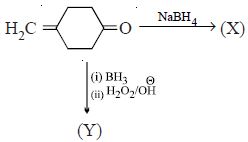
In the given reaction $(X)$ and $(Y)$ are :
Give below are two statements:

Statement-$I$ : Noble gases have very high boiling points.

Statement-$II$: Noble gases are monoatomic gases. They are held together by strong dispersion forces. Because of this they are liquefied at very low temperature. Hence, they have very high boiling points. In the light of the above statements. choose the correct answer from the options given below:

The law of electrolysis were proposed by
${({C_2}{H_5}O)_2}CO\xrightarrow[{{H_3}{O^ + }}]{{C{H_3}MgBr(excess)}}A.$ $A$ (alcohol) can also be obtained by
In the following sequence of reaction 

${C_6}{H_5} - N{H_2}\xrightarrow[{HCl}]{{NaN{O_2}}}A\xrightarrow{{CuCN}}B\xrightarrow{{{H_2}/Ni}}C\xrightarrow{{HN{O_2}}}D$

product $(D)$ would be

Concentrated nitric acid oxidises cane sugar to
Which one of the following is an amino acid
The common features among the species $CN^-, CO$ and $NO^+$ are