MCQ
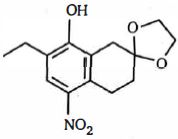
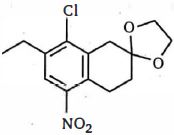
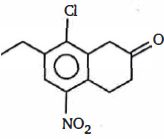
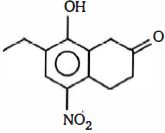
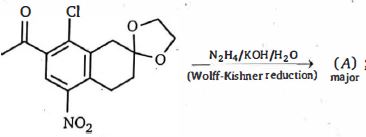
Product $A$ is

  • B

  • C

  • D

Answer

Correct option: A.

a
$(a)$ Wolff-Kishner as well as $SNAr$ both reaction take place.

Need a full question paper?

Generate a complete, print-ready paper with questions like this in minutes — across 16+ boards, with answer keys.
Start Generating Free

Similar questions

Heating white phosphorus with conc. $NaOH$ solution gives mainly
Which of the following pairs of ions are isoelectronic and isostructural?
Which of the following hormones contains iodine?
What is final product of this reaction ?
In a bimolecular reaction, the steric factor $P$ was experimentally determined to be $4.5$ . The correct option(s) among the following is(are)

$[A]$ The activation energy of the reaction is unaffected by the value of the steric factor

$[B]$ Experimentally determined value of frequency factor is higher than that predicted by Arrhenius equation

$[C]$ Since $P=4.5$, the reaction will not proceed unless an effective catalyst is used

$[D]$ The value of frequency factor predicted by Arrhenius equation is higher than that determined experimentally

When ether is reacted with ${O_2},$ it undergoes explosion due to
If $1$ molal solution of benzoic acid in benzene has a freezing point depression of $2.56\,^oC$.
$(K_f = 5.12\,^oC\,mol^{-1}\, kg)$ and boiling point elevation of $2.53\,^oC$ $(K_b = 2.53\,^oC\,mol^{-1}\,kg)$, then select the correct statement/s :
Statement $I :$ there is dimer formation when undergoing freezing.

Statement $II :$ there is no change when undergoing boiling

Statement $III :$ reverse of $I$ and $II$

Statement $IV :$ dimer formation in freezing and boiling state

Given below are two statements: One is labelled as Assertion $A$ and the other is labelled as Reason $R$.

Assertion $A:$ Butan$-1-$ol has higher boiling point than ethoxyethane.

Reason $R:$ Extensive hydrogen bonding leads to stronger association of molecules.

In the light of the above statements, choose the correct answer from the options given below:

A flask contains a mixture of compounds $A$ and $B.$ Both compounds decompose by first-order kinetics. The half-lives for $A$ and $B$ are $300$ $s$ and $180\, s ,$ respectively. If the concentrations of $A$ and $B$ are equal initially, the time required for the concentration of $A$ to be four times that of $B ($ in $s ):$ (Use $\ln 2=0.693)$


Proteins are: