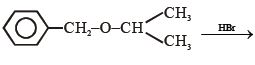
MCQ
Product $(A)$ of the reaction will be
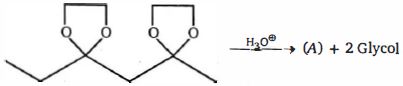
  • A
    $\begin{matrix}
       O\,\,\,\,\,\,\,\,\,\,\,\,\,\,\,\,\,\,\,\,\,\,\,\,\,\,\,\,O  \\
       ||\,\,\,\,\,\,\,\,\,\,\,\,\,\,\,\,\,\,\,\,\,\,\,\,\,\,\,\,||  \\
       C{{H}_{3}}-C{{H}_{2}}-C-C{{H}_{2}}-C-C{{H}_{2}}-C{{H}_{3}}  \\
    \end{matrix}$
  • B
    $\begin{matrix}
       \,\,\,\,\,\,\,\,\,\,\,\,\,\,\,\,\,\,\,\,O\,\,\,\,\,\,\,\,\,\,\,\,\,\,\,\,\,\,\,\,\,\,\,\,\,\,\,\,\,\,\,\,\,\,\,\,\,\,\,\,\,\,\,O  \\
       \,\,\,\,\,\,\,\,\,\,\,\,\,\,\,\,\,\,\,\,||\,\,\,\,\,\,\,\,\,\,\,\,\,\,\,\,\,\,\,\,\,\,\,\,\,\,\,\,\,\,\,\,\,\,\,\,\,\,\,\,\,\,\,\,||  \\
       C{{H}_{3}}-C{{H}_{2}}-C-C{{H}_{2}}-C{{H}_{2}}-C-C{{H}_{3}}  \\
    \end{matrix}$
  • $\begin{matrix}
       \,\,\,\,\,\,\,\,\,\,\,\,\,\,\,\,\,\,\,O\,\,\,\,\,\,\,\,\,\,\,\,\,\,\,\,\,\,\,\,\,\,\,\,\,\,\,\,\,O  \\
       \,\,\,\,\,\,\,\,\,\,\,\,\,\,\,\,\,\,\,||\,\,\,\,\,\,\,\,\,\,\,\,\,\,\,\,\,\,\,\,\,\,\,\,\,\,\,\,\,\,||  \\
       C{{H}_{3}}-C{{H}_{2}}-C-C{{H}_{2}}-C-C{{H}_{3}}  \\
    \end{matrix}$
  • D
    $\begin{matrix}
       O\,\,\,\,\,\,\,\,\,\,\,\,\,\,\,\,\,\,\,\,\,\,\,\,\,\,\,O  \\
       ||\,\,\,\,\,\,\,\,\,\,\,\,\,\,\,\,\,\,\,\,\,\,\,\,\,\,||  \\
       C{{H}_{3}}-C-C{{H}_{2}}-C-C{{H}_{3}}  \\
    \end{matrix}$
Answer

Correct option: C.
$\begin{matrix}
   \,\,\,\,\,\,\,\,\,\,\,\,\,\,\,\,\,\,\,O\,\,\,\,\,\,\,\,\,\,\,\,\,\,\,\,\,\,\,\,\,\,\,\,\,\,\,\,\,O  \\
   \,\,\,\,\,\,\,\,\,\,\,\,\,\,\,\,\,\,\,||\,\,\,\,\,\,\,\,\,\,\,\,\,\,\,\,\,\,\,\,\,\,\,\,\,\,\,\,\,\,||  \\
   C{{H}_{3}}-C{{H}_{2}}-C-C{{H}_{2}}-C-C{{H}_{3}}  \\
\end{matrix}$
c
$(c)$ Hydrolysis of ether.

Need a full question paper?

Generate a complete, print-ready paper with questions like this in minutes — across 16+ boards, with answer keys.

Start Generating Free

Similar questions

Product/s not obtained in the following reaction is 
The total possible coordination isomers for the following compounds respectively  are :

$[Co(en)_3]\,[Cr(C_2O_4)_3]$

$[Cu(NH_3)_4]\, [CuCl_4]$

$[Ni(en)_3]\,[Co(NO_2)_6]$

Colligative properties of a solution depends upon
$C _{12} H _{22} O _{11}+ H _{2} O \stackrel{\text { Enzyme A }}{\longrightarrow} C _{6} H _{12} O _{6}+ C _{6} H _{12} O _{6}$

Sucrose $\quad$ $\quad$ $\quad$ $\quad$ $\quad$ $\quad$ $\quad$ Glucose $\quad$ Fructose

$C _{6} H _{12} O _{6} \stackrel{\text { Enzyme B }}{\longrightarrow} 2 C _{2} H _{5} OH +2 CO _{2}$

Glucose

In the above reactions, the enzyme $A$ and enzyme $B$ respectively are :-

Melting point of  $FeCl_3$  and  $FeCl_2$  is
$p_A$ and $p_B$ are the vapour pressure of pure liquid components, $A$ and $B,$ respectively of an ideal binary solution. If $x_A$ represents the mole fraction of component $A,$ the total pressure of the solution will be
Compare rate of reaction with $AgNO_3$
What will be the pH of solution which is in contact with hydrogen electrode having oxidation potential 0.177 V?
$\begin{array}{*{20}{c}}
  {\,\,\,\,\,\,\,\,\,\,\,\,\,\,\,\,\,\,\,\,\,\,\,\,\,\,\,\,\,\,\,\,\,\,\,\,\,\,\,\,\,\,\,\begin{array}{*{20}{c}}
  {\,\,\,\,\,\,\,\,\,\,\,\,\,\,\,\,\,\,\,\,\,\,\,\,\,\,\,\,\,\,HOC{H_2}} \\ 
  \,\,\,\,\,\,\,\,\,\,\,\,\,\,\,\,| 
\end{array}} \\ 
  {{H_2}C = CH - C{H_2} - C{H_2} - C - OH} \\ 
  {\,\,\,\,\,\,\,\,\,\,\,\,\,\,\,\,\,\,\,\,\,\,\,\,\,\,\,\,\,\,\,\,\,\,\,\,\,\,\,\,\,\,\,\,\,\,\,\,\,\,\,\,\,\,\,\,\,|} \\ 
  {\,\,\,\,\,\,\,\,\,\,\,\,\,\,\,\,\,\,\,\,\,\,\,\,\,\,\,\,\,\,\,\,\,\,\,\,\,\,\,\,\,\,\,\,\,\,\,\,\,\,\,\,\,\,\,\,\,\,\,\,\,\,\,\,\,\,\,\,\,\,\,\,\,\,\,\,\,\,\,\,\,\,\,C{H_2} - C{H_3}} 
\end{array}$ $\xrightarrow[{TsOH}]{{\begin{array}{*{20}{c}}
  O \\ 
  {||} \\ 
  {C{H_3} - C - C{H_3}} 
\end{array}}}(A)$ $\xrightarrow[{{{(C{H_3})}_2}S}]{{{O_3}}}(B) + HCHO$ Product $(B)$ is
product is ?