MCQ
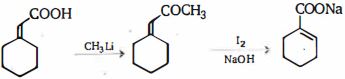
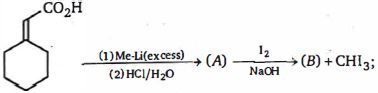
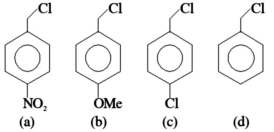
Product $(B)$ in this reaction is
  • B

  • C

  • D

Answer

Correct option: A.

a

Need a full question paper?

Generate a complete, print-ready paper with questions like this in minutes — across 16+ boards, with answer keys.

Start Generating Free

Similar questions

${E^o}$ for the cell $Zn|Z{n^{2 + }}(aq)||C{u^{2 + }}(aq)|Cu$ is $1.10\,V$ at ${25\,^o}C$, the equilibrium constant for the reaction $Zn + C{u^{2 + }}(aq)$ $\rightleftharpoons$ $Cu + Z{n^{2 + }}(aq)$ is of the order of
Faraday has the dimensions of
The number of $4 f$ electrons in the ground state electronic configuration of $\mathrm{Gd}^{2+}$ is ........ .

[Atomic number of $\mathrm{Gd}=64$ ]
The hypothetical complex triamminediaquachloro cobalt $(III)$ chloride can be represented as
Which of the following condition will increase the voltage of the cell, represented by the equation $C{u_{(s)}} + 2A{g^ + }_{(aq)} \to C{u^{2 + }}_{(aq)} + 2A{g_{(s)}}$
Which of the following is not an amine?
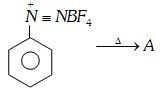
In this process product  $A $ is
Decreasing order towards $S_N 1$ reaction for the following compounds is:
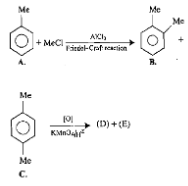
Consider the following reaction: The compound $D$ is an ortho$-$isomer and $E$ is a $p−$isomer. The compounds $D$ and $E,$ respectively are:
When a metal rod ${M}$ is dipped into an aqueous colourless concentrated solution of compound ${N}$, the solution turns light blue. Addition of aqueous $\mathrm{NaCl}$ to the blue solution gives a white precipitate ${O}$. Addition of aqueous $\mathrm{NH}_3$ dissolves ${O}$ and gives an intense blue solution.

$1.$ The metal rod ${M}$ is

$(A)$ $\mathrm{Fe}$ $(B)$ $\mathrm{Cu}$ $(C)$ $\mathrm{Ni}$ $(D)$ $\mathrm{Co}$

$2.$ The compound ${N}$ is

$(A)$ $\mathrm{AgNO}_3$ $(B)$ $\mathrm{Zn}\left(\mathrm{NO}_3\right)_2$

$(C)$ $\mathrm{Al}\left(\mathrm{NO}_3\right)_3$ $(D)$ $\mathrm{Pb}\left(\mathrm{NO}_3\right)_2$

$3.$ The final solution contains

$(A)$ $\left[\mathrm{Pb}\left(\mathrm{NH}_3\right)_4\right]^{2+}$ and $\left[\mathrm{CoCl}_4\right]^{2-}$

$(B)$ $\left[\mathrm{Al}\left(\mathrm{NH}_3\right)_4\right]^{3+}$ and $\left[\mathrm{Cu}\left(\mathrm{NH}_3\right)_4\right]^{2+}$

$(C)$ $\left[\mathrm{Ag}\left(\mathrm{NH}_3\right)_2\right]^{+}$and $\left[\mathrm{Cu}\left(\mathrm{NH}_3\right)_4\right]^{2+}$

$(D)$ $\left[\mathrm{Ag}\left(\mathrm{NH}_3\right)_2\right]^{+}$and $\left[\mathrm{Ni}\left(\mathrm{NH}_3\right)_6\right]^{2+}$

Give the answer question $1,2$ and $3.$