MCQ
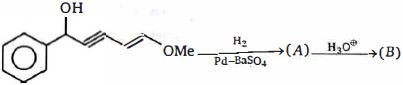
Product $(B)$ is
  • A
    $\begin{matrix}
       OH\,\,\,\,\,\,\,\,\,\,\,\,\,\,\,\,\,\,\,  \\
       |\,\,\,\,\,\,\,\,\,\,\,\,\,\,\,\,\,\,\,\,\,\,\,\,\,\,\,  \\
       Ph-CH-CH=CH-  \\
    \end{matrix}\begin{matrix}
       \,\,\,\,\,O  \\
       \,\,\,\,\,||  \\
       C{{H}_{2}}-C-H  \\
    \end{matrix}$
  • B
    $Ph -CH = CH -CHO$
  • $Ph - (CH = CH)_2 -CHO$
  • D
    $Ph - (CH = CH)_3 -CHO$

Answer

Correct option: C.
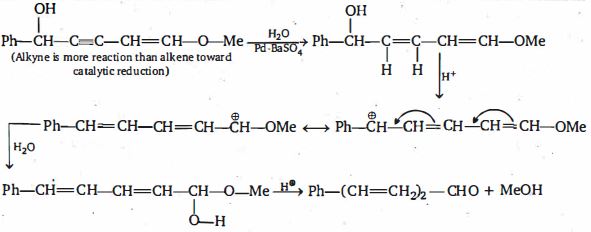
$Ph - (CH = CH)_2 -CHO$
c

Need a full question paper?

Generate a complete, print-ready paper with questions like this in minutes — across 16+ boards, with answer keys.

Start Generating Free

Similar questions

Amide group is present in
The products formed in the following reaction.
A catalyst lowers the activation energy for a certain reaction from $83.314$ to $75 \,KJ\,mol^{-1}$ at $500\,K$ . What will be the rate of reaction as compare to uncatalysed reaction ? Assume other things being equal ....... $times$
On reaction of $38.1\, g$ iodine and $28.4\, g$ chlorine, mixture of $ICl$ and $ICl_3$ is obtained then total number of moles after reaction will be
The number of electrons to balance the following equation $NO_3^ - + 4{H^ + } + {e^ - }\, \to \,2{H_2}O + NO$ is
Which of the following sets of reagents, used in the order shown, would be enable for the preparation of $p-$ chlorophenol from $p-$ chloronitrobenzene ?
For the reaction $\mathrm{N}_2 \mathrm{O}_4(\mathrm{~g}) \rightleftharpoons 2 \ \mathrm{NO}_2(\mathrm{~g})$, $\mathrm{K}_{\mathrm{p}}=0.492 \mathrm{~atm}$ at $300 \mathrm{~K} . \mathrm{K}_{\mathrm{c}}$ for the reaction at same temperature is_________ $\quad \times 10^{-2}$. (Given : $\mathrm{R}=0.082 \mathrm{~L} \mathrm{~atm} \mathrm{~mol}^{-1} \mathrm{~K}^{-1}$ )
The Henry law constant for dissolution of a gas in aqueous medium is $3 × 10^2$  $atm$. At what partial pressure of the gas, the molality of gas in aqueous solution will be $\frac{5}{9}\,m$.
Which of the following have different number of $p_{\pi} -d_{\pi}$ bonds present as ompared to other molecule ?
Complete reaction of acetaldehyde with excess formaldehyde, upon heating with conc. $NaOH$ solution, gives $P$ and $Q$. Compound $P$ does not give Tollens' test, whereas $Q$ on acidification gives positive Tollens' test. Treatment of $P$ with excess cyclohexanone in the presence of catalytic amount of $p$-toluenesulfonic acid (PTSA) gives product $R$.

Sum of the number of methylene groups $\left(- CH _2-\right.$ ) and oxygen atoms in $R$ is. . . .