MCQ
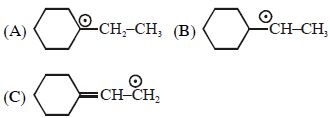
Product $(B)$ is
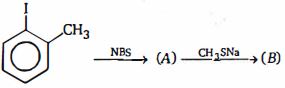
- ✓
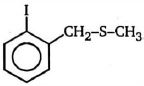
- B
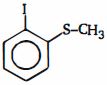
- C
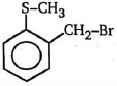
- DNone of these

Generate a complete, print-ready paper with questions like this in minutes — across 16+ boards, with answer keys.
$N{H_3}(g) \rightleftharpoons \frac{1}{2}{N_2}(g) + \frac{3}{2}{H_2}(g)$ What is the $K_P$ for following reaction ? ${N_2}(g) + 3{H_2}(g) \rightleftharpoons 2N{H_3}(g)$
$A$. The strength of anionic ligands can be explained by crystal field theory.
$B$. Valence bond theory does not give a quantitative interpretation of kinetic stability of coordination compounds.
$C$. The hybridization involved in formation of $\left[\mathrm{Ni}(\mathrm{CN})_4\right]^{2-}$ complex is $\mathrm{dsp}^2$.
$D$. The number of possible isomer$(s)$ of cis- $\left[\mathrm{PtCl}_2(\text { en })_2\right]^{2+}$ is one
Choose the correct answer from the options given below: