MCQ
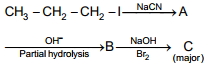
Product $(B)$ is :
  • A


  • C

  • D

Answer

Correct option: B.

b
The chemical reaction is shown below :

Need a full question paper?

Generate a complete, print-ready paper with questions like this in minutes — across 16+ boards, with answer keys.

Start Generating Free

Similar questions

The first element of rare–earth metals is
Match the Xenon compounds in Column$-I$ with its structure in Column$-II$ and assign the correct code

Column$-I$ Column$-II$
$(a)$ $\mathrm{XeF}_{4}$ $(i)$ pyramidal
$(b)$ $\mathrm{XeF}_{6} $ $(ii)$ square planar
$(c)$ $\mathrm{XeOF}_{4}$ $(iii)$ distorted octahedral
$(d)$ $\mathrm{XeO}_{3} $ $(iv)$ square pyramidal

code : $(a) \quad (b)\quad  (c) \quad (d)$

The Henry's law constant for solubility of $N_2$ gas in water at $25\,^oC$ is $1 \times 10^5\ atm$ . The mole fraction of $N_2$ in air is $0.8$ . The number of moles of $N_2$ from air that will dissolve in $10\, moles$ of $H_2O$ at $25\,^oC$ and at $5\ atm$ pressure
The vapour pressure of pure water at $25\,^oC$ is $23.62\, mm$. What will be the vapour pressure of a solution of $1.5\, g$ urea in $50\, g$ water ? .......... $mm$
Identify the major product $\mathrm{C}$ formed in the following reaction sequence:

$Image$

Rusting of iron is catalysed by which of the following
When phenyl magnesium bromide reacts with $t-$butanol, the product would be
$p-$ cresol reacts with chloroform in alkaline medium to give the compound $A$ which adds hydrogen cyanide to form, the compound $B$. The latter on acidic hydrolysis gives chiral carboxylic acid. The structure of the carboxylic acid is
Molar ionic conductivities of divalent cation and anion are $57 \mathrm{~S} \mathrm{~cm}^2 \mathrm{~mol}^{-1}$ and $73 \mathrm{~S} \mathrm{~cm}^2 \mathrm{~mol}^{-1}$ respectively. The molar conductivity of solution of an electrolyte with the above cation and anion will be :
Which type of ores are concentrated by froth flotation process?