MCQ
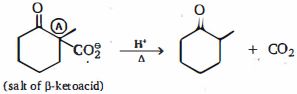
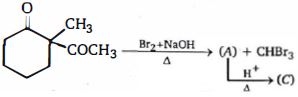
Product $(C)$ of the reaction is
  • A


  • C

  • D

Answer

Correct option: B.

b

Need a full question paper?

Generate a complete, print-ready paper with questions like this in minutes — across 16+ boards, with answer keys.
Start Generating Free

Similar questions

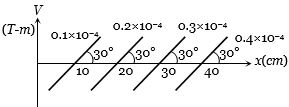
Some equipotential surfaces of the magnetic scalar potential are shown in the figure. Magnetic field at a point in the region is
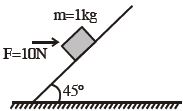
A body of mass $1\, kg$ lies on smooth inclined plane. The body is given force $F = 10N$  horizontally as shown. The magnitude of net normal reaction on the body is 
Let kinetic energy of a satellite is $x$, then its time of revolution $T$ is proportional to ..............
A paramagnetic sample shows a net magnetisation of $6 \,A / m$ when it is placed in an external magnetic field of $0.4 \,T$ at a temperature of $4\, K$. When the sample is placed in an external magnetic field of $0.3\, T$ at a temperature of $24\, K$, then the magnetisation will be$......A/m$
The range of the projectile projected at an angle of $15^{\circ}$ with horizontal is $50\,m$. If the projectile is projected with same velocity at an angle of $45^{\circ}$ with horizontal, then its range will be $........\,m$
Assertion : It is not possible to use ${}^{35}Cl$ as the fuel for fusion energy.

Reason : The binding energy of ${}^{35}Cl$ is too small.

An open pipe of length $l$ vibrates in fundamental mode. The pressure variation is maximum at
A closed organ pipe of length $1.2 \,\,m$ vibrates in its first overtone mode. The pressure variation is maximum at:
A particle has initial velocity $10\,\, m/s$. It moves due to constant retarding force along the line of velocity which produces a retardation of $5\,\, m/s^2$. Then
Two spherical planets $P$ and $Q$ have the same unfirom density $\rho$, masses $M_p$ and $M_Q$, an surface areas $A$ and $4 A$, respectively. A spherical planet $R$ also has unfirom density $\rho$ and its mass is $\left(M_p+M_Q\right)$. The escape velocities from the planets $P, Q$ and $R$, are $V_P, V_Q$ and $V$ respectivley. Then

$(A)$ $V_Q>V_R>V_P$

$(B)$ $V_R>V_Q>V_P$

$(C)$ $V _{ R } / V _{ P }=3$

$(D)$ $V_p / N_Q=\frac{1}{2}$