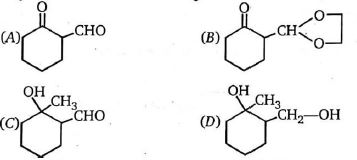
MCQ
Product $(D)$ in above reaction is

  • A


  • C

  • D

Answer

Correct option: B.

b

Need a full question paper?

Generate a complete, print-ready paper with questions like this in minutes — across 16+ boards, with answer keys.

Start Generating Free

Similar questions

A first row transition metal with highest enthalpy of atomisation, upon reaction with oxygen at high temperature forms oxides of formula $\mathrm{M}_2 \mathrm{O}_{\mathrm{n}}$ (where $\mathrm{n}=3,4,5$ ). The 'spin-only' magnetic moment value of the amphoteric oxide from the above oxides is. . . . . . ..$\mathrm{BM}$ (near integer)

(Given atomic number: $\mathrm{Sc}: 21, \mathrm{Ti}: 22, \mathrm{~V}: 23$, $\mathrm{Cr}: 24, \mathrm{Mn}: 25, \mathrm{Fe}: 26, \mathrm{Co}: 27, \mathrm{Ni}: 28, \mathrm{Cu}: 29$, $\mathrm{Zn}: 30)$

Phenol is obtained by heating aqueous solution of
$1$ mole of liquid $A$ and $9$ moles of liquid $B$ are mixed to form a solution. If $\text{P}^\circ_\text{B}​=400_\text{mm}$ of $Hg$ and $\text{P}^\circ_\text{B}​=200_\text{mm}$ of $Hg$ at a temperature $'T\ '$ and normal boiling point of liquid $B$ is $300K$ then answer the questions that follow. Given data$:\ K_b ​= 2.7K \ kg\ mol^{-1}$, Molar mass of $B = 100$ If $'A\ '$ is perfectly non$-$volatile and it dimerises to an extent of $60\%$ then what will be the vapour pressure of the solution.
The complexes $[Co(NH_3)_6][Cr(CN)_6]$ and $[Cr(NH_3)_6][Co(CN)_6]$ are the examples of which type of isomerism?
Which of the following compounds exhibits linkage isomerism
Phosgene is the common name of
Isotonic solutions have same
In the reaction ${C_8}{H_6}{O_4}\xrightarrow{\Delta }X\xrightarrow{{N{H_3}}}$ The compound $X$ is
Which of the statements about "Denaturation" given below are correct ?

$(1)$ Denaturation of proteins causes loss of secondary and tertiary structures of the protein.

$(2)$ Denaturation leads to the conversion of double strand of $DNA$ into single strand.

$(3)$ Denaturation affects primary structure which gets distorted.

The electrolytes usually used in the electroplating of gold and silver, respectively, are