MCQ
Product obtained in above reactions $(1), (2)$ & $(3)$ is
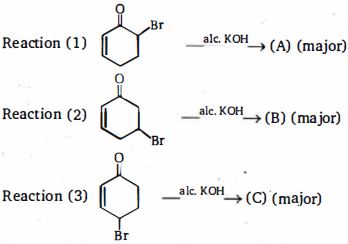
- A$A = B$ but $C$ -is different
- B$A = C,$ but $B$ is different
- C$B = C,$ but $A$ is different
- ✓$A = B = C$ all product are identical

Generate a complete, print-ready paper with questions like this in minutes — across 16+ boards, with answer keys.
$\mathrm{H}_2, \mathrm{He}_2^{+}, \mathrm{O}_2^{+}, \mathrm{N}_2^{2-}, \mathrm{O}_2^{2-}, \mathrm{F}_2, \mathrm{Ne}_2^{+}, \mathrm{B}_2$

| Column $I$ | Column $II$ | ||
| $(A)$ | Kohlrausch law can calculate | $(P)$ | $\frac{{\Lambda _m^c}}{{\Lambda _m^o}}$ |
| $(B)$ | Molar conductance ${\Lambda _m}$ | $(Q)$ | $\frac{1}{R} \times \frac{l}{A}$ |
| $(C)$ | Specific conductance Kappa $\to (k)$ | $(R)$ | $\Lambda _m^o\,of\,c{a_3}{(P{O_4})_2}$ |
| $(D)$ | Degree of ionization of weak electrolyte | $(S)$ | $\frac{{k \times 1000}}{M}$ |
Which of the following option show correct matches
$(a)$ $H _{2} C _{2} O _{4} \rightleftharpoons H ^{+}+ HC _{2} O _{4}^{-}$
$(b)$ $HC _{2} O _{4}^{-} \rightleftharpoons H ^{+}+ HC _{2} O _{4}^{2-}$
$(c)$ $H _{2} C _{2} O _{4} \rightleftharpoons 2 H ^{+}+ C _{2} O _{4}^{2-}$
The relationship between $K_{a_{1}}, K_{ a _{2}}$ and $K_{ a _{3}}$ is given as