MCQ
Product Obtained is :
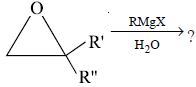
  • A
    $\begin{array}{*{20}{c}}
      {R\,\,\,\,\,\,\,\,\,\,\,\,\,} \\ 
      {|\,\,\,\,\,\,\,\,\,\,\,\,\,\,} \\ 
      {R' - C - C{H_2}OH} \\ 
      {|\,\,\,\,\,\,\,\,\,\,\,\,\,\,} \\ 
      {R\,\,\,\,\,\,\,\,\,\,\,\,} 
    \end{array}$
  • $\begin{array}{*{20}{c}}
      {\,\,\,\,\,\,\,\,R'} \\ 
      {\,\,\,\,\,|} \\ 
      {RC{H_2} - C - OH} \\ 
      {\,\,\,\,|} \\ 
      {\,\,\,\,\,R} 
    \end{array}$
  • C
    $\begin{array}{*{20}{c}}
      {\,\,\,\,\,\,\,\,\,R\,} \\ 
      {\,\,\,\,\,\,\,|} \\ 
      {R'C{H_2} - C - OH} \\ 
      {\,\,\,\,\,\,|} \\ 
      {\,\,\,\,\,\,\,R} 
    \end{array}$
  • D
    $\begin{array}{*{20}{c}}
      {\,\,\,\,\,\,\,R\,} \\ 
      {\,\,\,\,\,|} \\ 
      {RC{H_2} - C - OH} \\ 
      {\,\,\,\,|} \\ 
      {\,\,\,\,\,R'} 
    \end{array}$
Answer

Correct option: B.
$\begin{array}{*{20}{c}}
  {\,\,\,\,\,\,\,\,R'} \\ 
  {\,\,\,\,\,|} \\ 
  {RC{H_2} - C - OH} \\ 
  {\,\,\,\,|} \\ 
  {\,\,\,\,\,R} 
\end{array}$
b

Need a full question paper?

Generate a complete, print-ready paper with questions like this in minutes — across 16+ boards, with answer keys.

Start Generating Free

Similar questions

A certain mass of an ideal gas absorbs $80\ kJ$ heat and gas is expanded from $2\,L$ to $10\,L$  at constant pressure of $25\,bar$ . What is $\Delta U$ for gas in the process.......$kJ$ ( $1\ bar - L = 100\ J$ )
For the reaction $2 \mathrm{NO}_{2}(\mathrm{~g}) \rightleftharpoons \mathrm{N}_{2} \mathrm{O}_{4}(\mathrm{~g})$, when $\Delta \mathrm{S}=-176.0\, \mathrm{JK}^{-1}$ and $\Delta \mathrm{H}=-57.8\, \mathrm{~kJ}\, \mathrm{~mol}^{-1}$, the magnitude of $\Delta \mathrm{G}$ at $298\, \mathrm{~K}$ for the reaction is $......\,\mathrm{kJ} \mathrm{mol}^{-1} .$ (Nearest integer)
Which can show geometrical isomerism ?
The heat of neutralization of a strong acid and a strong alkali is $-57.0\,kJ\,mol^{-1}$ . The heat released when $0.5\,mole$ of $HNO_3$ solution is mixed with $0.2\,mole$ of $KOH$ is ....$kJ$
The simplest formula of a compound containing $50\%$ of element $X$ (atomic mass $10$) and $50\%$ of element $Y$ (atomic mass $20$) is
For which of the following reaction, product formation is favoured at low pressure and low temperature ?
Octane number can be changed by
When in any system at equilibrium state pressure, temperature and concentration is changed then the equilibria shifted to such a direction which neutralize the effect of change. This is known as
According to Bohr's theory,

$\mathrm{E}_{\mathrm{n}}=$ Total energy, $\mathrm{K}_{\mathrm{n}}=$ Kinetic energy, $\mathrm{V}_{\mathrm{n}}=$ Potential energy , $\mathrm{r}_{\mathrm{n}}=$ Radius of $\mathrm{n}^{\text {th }}$ orbit

Match the following:

Column $I$ Column $II$
$(A)$ $\mathrm{V}_{\mathrm{n}} / \mathrm{K}_{\mathrm{n}}=$ ? $(P)$ $0$
$(B)$ If radius of $n^{\text {th }}$ orbit $\propto E_n^x, x=$ ? $(Q)$ $-1$
$(C)$ Angular momentum in lowest orbital $(R)$ $-2$
$(D)$ $\frac{1}{\mathrm{r}^{\mathrm{n}}} \propto \mathrm{Z}^{\mathrm{y}}, \mathrm{y}=$ ? $(S)$ $1$
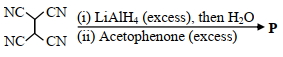
The total number of $\mathrm{sp}^2$ hybridised carbon atoms in the major product $P$ (a non-heterocyclic compound) of the following reaction is. . . . . . .