MCQ
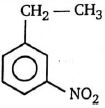
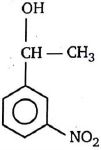
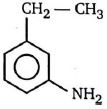
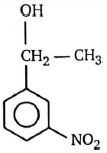
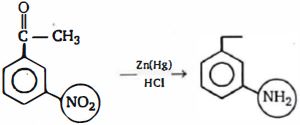
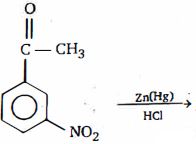
Product of the Clemmensen reduction is
  • A

  • B


  • D

Answer

Correct option: C.

c

Need a full question paper?

Generate a complete, print-ready paper with questions like this in minutes — across 16+ boards, with answer keys.

Start Generating Free

Similar questions

Compare the two methods shown for the preparation of carboxylic acids

Method $1\,:\,$ $RBr\xrightarrow[diethyl\,\,ether]{Mg}RMgBr\xrightarrow[2.\,{{H}_{3}}{{O}^{+}}]{1.\,C{{O}_{2}}}RC{{O}_{2}}H$

Method $2\,:\,$ $RBr\xrightarrow{NaCN}RCN\xrightarrow[heat]{{{H}_{2}}O,HCl}RC{{O}_{2}}H$

Which one of the following statements correctly describes this conversion ?

Given below are two statements: one is labelled as Assertion $(A)$ and other is labelled as Reason $(R).$

Assertion $(A) :$ Sucrose is a disaccharide and a non-reducing sugar.

Reason $(R) :$ Sucrose involves glycosidic linkage between $C_{1}$ of $\beta$-glucose and $C_{2}$ of $\alpha$-fructose.

Choose the most appropriate answer from the options given below :

The rate of a first order reaction is $1.5 \times {10^{ - 2}}\;mol{L^{ - 1}}\;{\min ^{ - 1}}$ at $0.5\, M $ concentration of the reactant. The half life of the reaction is ....... $\min$
The number of given statement/s which is/are correct is $.....$.

$(A)$ The stronger the temperature dependence of the rate constant, the higher is the activation energy.

$(B)$ If a reaction has zero activation energy, its rate is independent of temperature.

$(C)$ The stronger the temperature dependence of the rate constant, the smaller is the activation energy.

$(D)$ If there is no correlation between the temperature and the rate constant then it means that the reaction has negative activation energy.

Which of the following solutions will have the highest boiling point
An organic compound $‘X’$ showing the following solubility profile is

$'X'\,\,\xrightarrow{{water}}$  Insoluble

$'X'\xrightarrow{{5\% \,HCl}}$  Insoluble

$'X'\xrightarrow{{10\% \,NaOH}}$  Insoluble

$'X'\xrightarrow{{10\% \,NaHC{O_3}}}$  Insoluble

$\mathrm{C}_6 \mathrm{H}_{13} \mathrm{Br}+\mathrm{OH}^{-} \longrightarrow \mathrm{C}_6 \mathrm{H}_{13} \mathrm{OH}+\mathrm{Br}^{-}$  is an example of:
Assertion : Phenol on oxidation with $KMnO_4$ gives meso-tartaric acid.
Reason : Pure phenol is colourless but turns pink due to oxidation to phenoquinone.
Benzyl Bromide on reaction with magnesium in the presence of dry ether gives $'X'$. $'X'$ on reaction with ethanol gives $'Y'$ Then the compound $Y$ is
'A' salt which gives green flame with bunsen burner, on reaction with dil. $H_2SO_4$ produces gas $(2)$ and white turbidity $(Z)$. The saturated solution of gas $(2)$ on reaction with $H_2S$ gas produces '$Z$' then select $CORRECT$ statement