MCQ
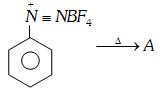
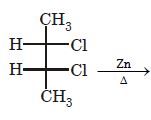
product $(P)$ , $P$ is
- A

- B

- ✓

- D

Generate a complete, print-ready paper with questions like this in minutes — across 16+ boards, with answer keys.
$(i)\,\, Cl^-$ can give up an electron more easily than $F^-$
$(ii) \,\,Cl^-$ is a better reducing agent than $F^-$
$(iii)\,\, Cl^-$ is smaller in size than $F^-$
$(iv)\,\, F^-$ can be oxidized more readily than $Cl^-$
[Given : molar mass of $Br _2=160\,g\,mol ^{-1}$
atomic mass of $C =12\,g\,mol ^{-1}$
atomic mass of $Cl =35.5\,g\,mol ^{-1}$
density of dibromine $=3.2\,g\,cm ^{-3}$
density of $\left.CCl _4=1.6\,g\,cm ^{-3}\right]$
Reason : Fluorine has $2s^2\,2p^5$ configuration.