MCQ
Product $(s)$ formed during this reaction is/are

- A
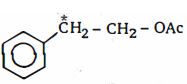
- B
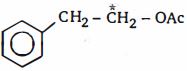
- C
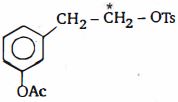
- ✓Both $(a)$ & $(b)$

Generate a complete, print-ready paper with questions like this in minutes — across 16+ boards, with answer keys.
$\mathop {C{H_3} - \mathop C\limits^ \oplus H - C{H_3}}\limits_I $
$\mathop {C{H_3} - \mathop C\limits^ \oplus H - OC{H_3}}\limits_{II} $
$\mathop {C{H_3} - \mathop C\limits^ \oplus H - C{H_2} - OC{H_3}}\limits_{III} $
($A$) a high activation energy usually implies a fast reaction.
($B$) rate constant increases with increase in temperature. This is due to a greater number of collisions whose energy exceeds the activation energy.
($C$) higher the magnitude of activation energy, stronger is the temperature dependence of the rate constant.
($D$) the pre-exponential factor is a measure of the rate at which collisions occur, irrespective of their energy.