MCQ
Product ; The Product is
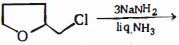
  • A

  • B
    $HC \equiv C - (CH_2)_3 ONa$
  • $NaC \equiv C - (CH_2)_3ONa$
  • D
    $H- C \equiv C- (CH_2)_3OH$

Answer

Correct option: C.
$NaC \equiv C - (CH_2)_3ONa$
c

Need a full question paper?

Generate a complete, print-ready paper with questions like this in minutes — across 16+ boards, with answer keys.

Start Generating Free

Similar questions

$C{H_3} - C{H_2} - C{H_2} - C \equiv CH\xrightarrow[{Excess}]{{HCl}}$ ?
Solubility product of $BaC{l_2}$ is $4 \times {10^{ - 9}}$. Its solubility in moles/litre would be
$XeF_{2(g)} + H_{2(g)} \to 2HF_{(g)} + Xe_{(g)}\, \Delta H^o = -430\, kJ$
Bond energy $\to H-H = 435\, kJ/mol$

                     $\to H-F = 565\, kJ/mol$
Calculate average bond energy of $Xe-F$ bond.....$ kJ/mol$

Identify the state function among the following
Which one of the following pairs represents stereoisomerism
Which compound is related to Haber's process
Which of the following is incorrectly matched ?

(Formation of)        (Best synthesis by)

$X\xrightarrow{{CoC{l_2}}}CaC{l_2} + Y\, \uparrow $; the effective ingredient of $X$ is
The relative reactivity of $1\,^oH, 2\,^oH$ and $3\,^oH$ in bromination reaction has been found to be $1 : 82 : 1600$ respectively. In the reaction

$\begin{array}{*{20}{c}}
  {C{H_3}\,\,\,\,\,\,\,\,\,\,\,\,\,\,\,\,\,\,\,\,\,\,\,\,\,\,\,\,\,\,\,\,\,\,\,\,\,\,\,\,\,\,\,} \\ 
  {|\,\,\,\,\,\,\,\,\,\,\,\,\,\,\,\,\,\,\,\,\,\,\,\,\,\,\,\,\,\,\,\,\,\,\,\,\,\,\,\,\,\,\,\,\,\,\,\,\,} \\ 
  {C{H_3} - CH - C{H_3}(excess) + B{r_2}\xrightarrow{{hv}}} 
\end{array}$ $\mathop {\begin{array}{*{20}{c}}
  {\,\,\,\,\,C{H_3}} \\ 
  | \\ 
  {C{H_3} - C - C{H_3}} \\ 
  | \\ 
  {\,\,Br} 
\end{array}}\limits_{(A)} $   +   $\mathop {\begin{array}{*{20}{c}}
  {C{H_3}\,\,\,\,\,\,\,\,\,\,} \\ 
  {\,\,|\,\,\,\,\,\,\,\,\,\,\,\,\,\,\,\,\,\,\,} \\ 
  {C{H_3} - CH - C{H_2} - Br} 
\end{array}}\limits_{(B)} $ 

the percentage yields of the products $(A)$ and $(B)$ are expected to be

The enthalpy of neutralisation of $NH_4OH$ with $HCl$ is $-51 .46\,kJ\,mol^{-1}$ and the enthalpy of neutralisation of $NaOH$ with $HCl$ is $-55. 90\,kJ\,mol^{-1}.$ The enthalpy of ionisation of $NH_4OH$ is......$kJ\,mol^{-1}$
