Question
Projection of vector $\vec A$ on $\vec B$ is

Answer

$A\,\cos \,\theta  = \frac{{\vec A.\vec B}}{{\left| {\vec B} \right|}} = \vec A.\hat B$

Need a full question paper?

Generate a complete, print-ready paper with questions like this in minutes — across 16+ boards, with answer keys.
Start Generating Free

Similar questions

$10$ resistors each of resistance $10\,\Omega$ can be connected in such as to get maximum and minimum equivalent resistance. The ratio of maximum and minimum equivalent resistance will be $..........$.
The potential energy for a force field $\overrightarrow{ F }$ is given by $U(x, y)=\cos (x+y)$. The force acting on a particle at position given by coordinates $(0, \pi / 4)$ is $-$
An $\alpha $ particle and a proton travel with same velocity in a magnetic field perpendicular to the direction of their velocities, find the ratio of the radii of their circular path
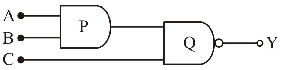
What is the output $Y$ in the following circuit, when all the three inputs $A,\, B,\, C$ are first $0$ and then $1$ ?
A balloon of mass $M$ is descending at a constant acceleration $\alpha $. When a mass $m$ is released from the balloon it starts rising with the same acceleration $\alpha $. Assuming that its volume does not change, what is the value of $m$ ?
Radioacitive nuclei $A$ and $B$ disintegrate into $C$ with half lives $T$ and $2T$. At $t = 0$, pumber of nuclei of each $A$ and $B$ is $x$. The number of nuclei of $C$ when rate of disintegration of $A$ and $B$ are equal is
A flat plate of area $0.1 \,m ^2$ is placed on a flat surface and is separated from it by a film of oil $10^{-5} \,m$ thick whose coefficient of viscosity is $1.5 N \,sm s ^{-2}$. The force required to cause the plate to slide on the surface at constant speed of $1 \,mm s ^{-1}$ is ............ $N$
When a projectile is fired at an angle $\theta$ w.r.t. horizontal component ignoring air resistance:
i. remains same
ii. goes on increasing with height
iii. goes on decreasing with height
iv. first increases then decrease with height
An electron (mass = $9.0 × $${10^{ - 31}}$ $kg$ and charge =$1.6 \times {10^{ - 19}}$ $coulomb$) is moving in a circular orbit in a magnetic field of $1.0 \times {10^{ - 4}}\,weber/{m^2}.$ Its period of revolution is
The amplitude of a damped oscillator becomes half in one minute. The amplitude after $3$ minute will be $\frac{1}{X}$ times the original, where $X$ is