MCQ
Propanal and pentan $- 3-$ one are ozonolysis product of
  • $\begin{array}{*{20}{c}}
      {C{H_3} - C{H_2} - CH = C - C{H_2}C{H_3}} \\ 
      {\,\,\,\,\,\,\,\,\,\,\,\,\,\,\,\,\,\,\,\,\,|\,} \\ 
      {\,\,\,\,\,\,\,\,\,\,\,\,\,\,\,\,\,\,\,\,\,\,\,\,\,\,\,\,\,\,\,\,\,C{H_2}C{H_3}} 
    \end{array}$
  • B
    $\begin{array}{*{20}{c}}
      {C{H_3} - CH = C - C{H_2} - C{H_3}} \\ 
      {\,\,\,\,\,\,\,\,\,\,\,\,\,\,\,\,\,\,\,\,\,|\,\,\,\,\,\,\,\,\,\,\,\,\,\,\,\,\,\,\,\,\,\,\,} \\ 
      {\,\,\,\,\,\,\,\,\,\,\,\,\,\,\,\,\,\,\,\,\,\,\,\,\,\,\,\,\,\,\,\,\,C{H_2}C{H_3}\,\,\,\,\,\,\,\,\,\,\,\,\,\,\,\,\,\,\,\,} 
    \end{array}$
  • C
    $\begin{array}{*{20}{c}}
      {C{H_3} - CH = C - C{H_3}} \\ 
      {\,\,\,\,\,\,\,\,\,\,\,\,\,\,\,||\,} \\ 
      {\,\,\,\,\,\,\,\,\,\,\,\,\,\,C{H_3} - C - C{H_3}} 
    \end{array}$
  • D
    $\begin{array}{*{20}{c}}
      {C{H_3} - CH = CH - CH - C{H_2} - C{H_2} - C{H_3}} \\ 
      {|\,\,\,\,\,\,\,} \\ 
      {C{H_3}\,} 
    \end{array}$
Answer

Correct option: A.
$\begin{array}{*{20}{c}}
  {C{H_3} - C{H_2} - CH = C - C{H_2}C{H_3}} \\ 
  {\,\,\,\,\,\,\,\,\,\,\,\,\,\,\,\,\,\,\,\,\,|\,} \\ 
  {\,\,\,\,\,\,\,\,\,\,\,\,\,\,\,\,\,\,\,\,\,\,\,\,\,\,\,\,\,\,\,\,\,C{H_2}C{H_3}} 
\end{array}$
a
$\mathop {\begin{array}{*{20}{c}}
  {C{H_3}C{H_2} - C = \boxed{O + O} = C - C{H_2}C{H_3}} \\ 
  {|\,\,\,\,\,\,\,\,\,\,\,\,\,\,\,\,\,\,\,\,\,\,\,\,\,\,\,\,\,\,\,\,\,\,\,\,|} \\ 
  {\,\,\,\,\,\,\,\,\,\,\,\,\,\,\,\,\,\,\,\,\,\,\,H\,\,\,\,\,\,\,\,\,\,\,\,\,\,\,\,\,\,\,\,\,\,\,\,\,\,\,\,\,\,\,\,\,C{H_2}C{H_{3\,\,\,\,\,\,}}} 
\end{array}}\limits_{\Pr opanal\,\,\,\,\,\,\,\,\,\,\,\,\,\,\,\,\,\,\,\,\,\,\,\,\,\,\,\,\,\,\,\,\,\,\,\,\,\,\,\,\,\,\,\,\,\,\,\,\,\,\,\,\,\,\,\,\,\,\,\,\,\,Pen\tan e - 3 - one} $ $ \to \begin{array}{*{20}{c}}
  {C{H_3}C{H_2} - CH = C - C{H_2}C{H_3}} \\ 
  {\,\,\,\,\,\,\,\,\,\,\,\,\,\,\,\,\,\,|} \\ 
  {\,\,\,\,\,\,\,\,\,\,\,\,\,\,\,\,\,\,\,\,\,\,\,\,\,\,\,\,\,\,\,\,C{H_2}C{H_3}} 
\end{array}$

Need a full question paper?

Generate a complete, print-ready paper with questions like this in minutes — across 16+ boards, with answer keys.

Start Generating Free

Similar questions

The $IUPAC$ name of $\begin{array}{*{20}{c}}
  {OH\,\,\,\,\,\,\,\,\,\,\,\,\,\,\,\,\,\,\,\,\,O} \\ 
  {|\,\,\,\,\,\,\,\,\,\,\,\,\,\,\,\,\,\,\,\,\,\,\,\,\,\,\,\,||} \\ 
  {C{H_3} - C - C{H_2} - C - C{H_3}} \\ 
  {\,|\,\,\,\,\,\,\,\,\,\,\,\,\,\,\,\,\,\,\,\,\,\,\,\,\,\,\,\,\,\,\,} \\ 
  {H\,\,\,\,\,\,\,\,\,\,\,\,\,\,\,\,\,\,\,\,\,\,\,\,\,\,\,\,\,\,} 
\end{array}$ is
Acetaldehyde reacts with ${C_2}{H_5}MgCl$ the final product is
Reaction of $R-2$ -butanol with $p$ -toluenesulphonyl chloride in pyridine then  $LiBr$ gives
Aldehyde and ketones can decolourize by
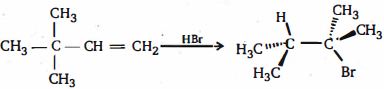
Consider the addition of $HBr$ to $3,3$ -Dimethyl- $1$ -butene shown below. What is  the best mechanistic explanation for the formation of the observed product ?
An oxide of copper which is red in colour has the formula
The Gibb's energy for the decomposition of $Al_2O_3$ at $500^oC$ is as follows

$\frac{2}{3} Al_2 O_3 \rightarrow \frac{4}{3} Al + O_2$

$\Delta _rG = + 960\, kJ\, mol^{-1}$

The potential difference needed for the electrolytic reduction of aluminium oxide $(Al_2O_3)$ at $500^oC$ is at least ........ $V$.

Which of the following may exist in enantiomorphs
Consider the following pairs of electrons

$(A)$ $(a)$ $n=3,1=1, m_{l}=1, m_{s}=+\frac{1}{2}$

$\quad (b)$ $n =3,1=2, m _{l}=1, m _{s}=+\frac{1}{2}$

$(B)$ $(a)$ $n =3,1=2, m _{l}=-2, m _{s}=-\frac{1}{2}$

$\quad (b)$ $n =3,1=2, m _{l}=-1, m _{s}=-\frac{1}{2}$

$(C)$ $(a)$ $n=4,1=2, m_{l}=2, m_{s}=+\frac{1}{2}$

$\quad (b)$ $n =3,1=2, m _{l}=2, m _{s}=+\frac{1}{2}$

The pairs of electron present in degenerate orbitals is/are...... .