MCQ
Propanal on treatment with dilute sodium hydroxide forms
  • A
    $CH_3CH_2CH_2CH_2CH_2CHO$
  • B
    $CH_3CH_2CH(OH)CH_2CH_2CHO$
  • $CH_3CH_2CH(OH)CH(CH_3)CHO$
  • D
    $CH_3CH_2COONa$

Answer

Correct option: C.
$CH_3CH_2CH(OH)CH(CH_3)CHO$
c

Need a full question paper?

Generate a complete, print-ready paper with questions like this in minutes — across 16+ boards, with answer keys.

Start Generating Free

Similar questions

Number of moles of $SnCl_2$ required for the reduction of $1$ mole of $K_2Cr_2O_7$ into $Cr_2O_3$ is (in acidic medium)
Given below are two statements:

Statement $I :$ Rutherford's gold foil experiment cannot explain the line spectrum of hydrogen atom.

Statement $II :$ Bohr'smodel of hydrogen atom contradicts Heisenberg's uncertainty principle.

In the light of the above statements, choose the most appropriate answer from the options given below :
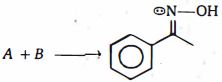
Reactant $(A)$ and $(B)$ is
The Henry's law constant for the solubility of $N_2$ gas in water at $298\, K$ is $1.0\times10^5\, atm$. The mole fraction of $N_2$ in air is $0.8$. The number of moles of $N_2$ from air dissolved in $10$ moles of water at $298\, K$ and $5\, atm$ pressure is
The density of a solution containing $13\%$ by mass of $H_2SO_4$ is $1.09\,gm/ml$. The molarity and normality of the solution are respectively :-
Which one is the weakest acid
$10.6\,grams$ of a substance of molecular weight $106 $ was dissolved in $100\,ml$. $10\,ml$ of this solution was pipetted out into a $1000\,ml$ flask and made up to the mark with distilled water. The molarity of the resulting solution is
The elements in which $s$ and $p$-orbitals are present
At $298\, K$, the standard electrode potentials of $Cu ^{2+} /$ $Cu , Zn ^{2+} / Zn , Fe ^{2+} / Fe$ and $Ag ^{+} / Ag$ are $0.34\, V$, $-0.76\, V ,-0.44\, V$ and $0.80\, V$, respectively.

On the basis of standard electrode potential, predict which of the following reaction can not occur ?

Which among the following electron transition $(n_2 → n_1)$ in $H-$ atom, minimum change in its orbit radius $(r_2 - r_1) $ is observed-