MCQ
Propene and propyne can be distinguished by
  • A
    $Br_2/CCl_4$
  • B
    Baeyer's Reagent
  • $AgNO_3 + NH_4OH$
  • D
    $O_3$

Answer

Correct option: C.
$AgNO_3 + NH_4OH$
c
$C{H_3} - CH = C{H_2}\xrightarrow{{AgN{O_3} + N{H_4}OH}}$ No reaction

$C{H_3} - C \equiv CH\xrightarrow{{AgN{O_3} + N{H_4}OH}}\mathop {C{H_3} - C \equiv \bar C\,Ag}\limits_{white\,ppt}  \downarrow $

Need a full question paper?

Generate a complete, print-ready paper with questions like this in minutes — across 16+ boards, with answer keys.
Start Generating Free

Similar questions

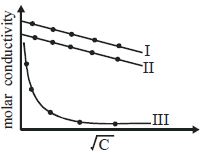
A graph was plotted between molar conductivity of various electrolytes ($NaCl, HCl$ and $NH_4OH$) and $\sqrt{C}$ (in $mol\, L^{-1}$). Correct setting
Among the following metals, the most dense is
Consider the following equation:

$2 SO _2( g )+ O _2( g ) \rightleftharpoons 2 SO _3( g ), \Delta H =-190\,kJ$

The number of factors which will increase the yield of $SO _3$ at equilibrium from the following is $.............$.

$A.$ Increasing temperature

$B.$ Increasing pressure

$C.$ Adding more $SO _2$

$D.$ Adding more $O _2$

$E.$ Addition of catalyst

Assign $A, B, C, D$ from given type of reaction. $NaN{O_2} + FeS{O_4} + {H_2}S{O_4} \longrightarrow \mathop {\left[ {Fe{{\left( {{H_2}O} \right)}_5}NO} \right]S{O_4}}\limits_{{\text{(Ring complex)}}} $
At constant temperature, the equilibrium constant $(K_p)$ for the decomposition reaction ${N_2}{O_4}$ $\rightleftharpoons$ $2N{O_2}$ is expressed by ${K_P} = \frac{{(4{x^2}P)}}{{(1 - {x^2})}}$, where $P = $ pressure, $x = $ extent of decomposition. Which one of the following statements is true
The correct order of increasing acid strenght of the compounds is

$(A)\, CH_3CO_2H$           $(B)\, MeOCH_2CO_2H$

$(C)\,CF_2CO_2H$           $(D)\,$ $Image$

An element $(X)$ forms compounds of the formula $XC{l_3},$ ${X_2}{O_5}$ and $C{a_3}{X_2},$ but does not form $XC{l_5}$, which of the following is the element $X$
Which substance is serving as a reducing agent in the following reaction $14{H^ + } + C{r_2}O_7^{2 - } + 3Ni \to 2C{r^{3 + }} + 7{H_2}O + 3N{i^{2 + }}$
The number of enantiomers of the compound $C{H_3}CHBrCHBrCOOH$ is
With the help of following reactions, arrange metals $A$, $B$, $D$ and $E$ in decreasing order of their reactivity

$(I)$ $B + ANO_3 \to  B NO_3 + A$

$(II)$ $A + HCl \to ACl + \frac{1}{2}{H_2}$

$(III)$ $D + ECl \to DCl + E$

$(IV)$ $D + HNO_3 \to H_2$ gas is not evolved